Person attributes


Other attributes
James Quentin Stafford-Fraser is a computer scientist and entrepreneur in Cambridge, England. He goes by Quentin in his web presence, but he is listed as James Stafford-Fraser on some of his older patents. He is most well-known for his involvement in the creation of the Trojan Room coffee pot, the world's first webcam. He is the founder of several technology and computer companies, including Telemarq Ltd and DisplayLink.
From 1986 to 1989, Stafford-Fraser attended Gonville & Caius College, a constituent college of the University of Cambridge, where he received a bachelor's degree in computer science and engineering. From 1992 to 1996, he attended the University of Cambridge, where he received a PhD in computer science.
Stafford-Fraser's career has involved a variety of both research and management roles in the computer science field. During his time at Gonville & Caius College from 1989 to 1981, he was a computer officer. As he attended the University of Cambridge, he was a research assistant for the school's computer lab from 1991 to 1992. During his PhD program from 1992 to 1996, he worked as a research student sponsored by Xerox EuroPARC, a research and development company. From 1996 to 2002, he was employed by AT&T Labs Cambridge as a research scientist.
Stafford-Fraser began holding management and director roles in 1999, when he worked as a technical director at Skillbytes Ltd. In 2002, he began to establish the Ndiyo Project. In 2003, he co-founded his first company, Newnham Research (now known as DisplayLink). In 2004, he co-founded Exbiblio. In 2007 he founded Camvine, and in 2011 he founded Telemarq.
As of 2021, Stafford-Fraser is the CEO of Telemarq and a senior research associate at the University of Cambridge.
Stafford-Fraser has established four companies and one not-for-profit organization: Telemarq, Camvine, Exbiblio, DisplayLink, and the Ndiyo Project, respectively.
Telemarq is a UK-based technology and communications company in Dunstable, Bedforshire, UK, founded in 2011. Their work includes software development, website creation, consultant work, video production, publishing, white papers, and more. Stafford-Fraser is the CEO of Telemarq as of 2021.
Camvine was a company started in 2007. It went out of business in 2012, due to "economic conditions." The company's goal was to "bring Internet-based management to the world of digital signage." Camvine created CODA, a simple computer system that lets users drag and drop files onto any network-connected display through a browser. The CODA technology still exists and was taken over by Numed Healthcare, with software development still being done by one of Stafford-Fraser's other companies, Telemarq.
Exbiblio was founded by both Stafford-Fraser and Martin King in 2004. The company ended when King died in 2010. Exbiblio created a technology that, in conjunction with an imaging device like a camera, was able to "scan" paper documents and match them to their digital counterparts in a faster way by extracting short word segments to then compare against the documents, instead of scanning page by page.
DisplayLink was originally founded as Newnham Research in 2003 by both Stafford-Fraser and Martin King. DisplayLink technology allows a computer display to be connected to any other computer with USB or WiFi connections. DisplayLink still exists under the control of a different company, Synaptics.
The Ndiyo Project was a not-for-profit, UK-based project from 2002-2010, founded by both Stafford-Fraser and Martin King. Its goal was to make networked computing more affordable and accessible to everyone by allowing a single PC running Linux, a multi-user operating system, to connect to multiple monitors and keyboards through an ethernet network. The Ndiyo Project was also what inspired Stafford-Fraser to create two of his other companies, Camvine and DisplayLink.
In 1991, Stafford-Fraser and Paul Jardetzky were attending the University of Cambridge together when they first created the concept of the Trojan Room coffee pot. The purpose of the invention was to allow their fellow peers working in the building to see exactly when the communal coffee pot was full in order to avoid making a "fruitless" trip to it from across the building and to avoid "disruption to the progress of computer science research." Stafford-Fraser and Jardetzky connected a video frame-grabber to a camera pointed at the communal coffee pot that sat outside the computer lab they used at the University, called the Trojan Room. Jardetzky created a server program to run on the frame-grabber that took several pictures per minute of the coffee pot. Stafford-Fraser created a client program, known as XCoffee, that connected to the server program. This enabled greyscale images of the coffee pot to appear on any locally connected computer for anyone to see.

Images from the Trojan Room Coffee Pot, three photos per minute (BBC news photo)
World Wide Web browsers were able to display images beginning in 1993. Two other computer scientists that worked in the same lab as Stafford-Fraser, Daniel Gordon and Martyn Johnson, connected the camera to the World Wide Web in late 1993. The Trojan Room coffee pot was then accessible to any Internet user in the world, and it effectively became the world's first webcam. The Trojan Room coffee pot soon became well-known among early World Wide Web users, with an estimated 2.4 million views in its eight total years spent online until 2001. It could be considered one of the earliest examples of viral phenomena on the Internet. It garnered press coverage over the years, with stories about it published in Wired and The Guardian, and news segments on channels across the world.
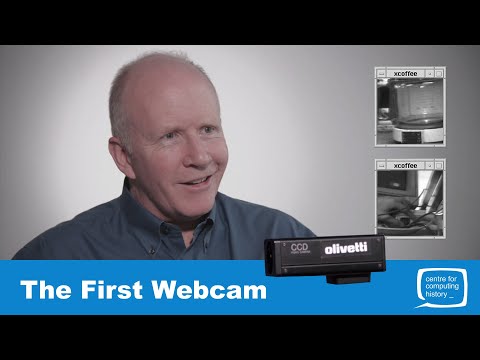
Quentin Stafford-Fraser, on the Trojan Room coffee pot (The Centre for Computing History)