
Technology attributes


Other attributes


Off-board sensors refers to the use of sensors for gathering data and developing intelligence, even in the case of military applications and the development of fine-grained, all-weather imagery, and surface moving target information for the guidance of a weapon system, without relying on on-board computers. For example, this would take off-board the elaborate intelligence-surveillance-reconnaissance suite of computers and sensors that are often on-board of an aircraft. The aircraft would then rely on off-board sensor systems to guide the aircraft and provide the necessary information for guidance.
This system relies on the use of satellites and space-based radar systems to provide persistent coverage with the necessary granularity. This which could lower the costs of systems, such as those in bombers or UAVs, which would only need to have a receiver computer to interpret the data as it is given to them, rather than including expensive sensor and computer systems. On-board systems could, in the case of a UAV, be destroyed, costing millions of dollars; the use of off-board sensors could further drive the cost of other vehicle platforms down and offer a chance to manufacture vehicle platforms faster than traditionally possible.

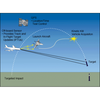
Image of Kratos drone using OBSS.
One such project, the Kratos, uses what the U.S. Air Force calls an off-board sensing station, or OBSS, which allows for the development of a low-cost, yet advanced drone. The Air Force Research Laboratory has previously stated the objectives of an OBSS system is to develop an open architecture aircraft concept that is capable of achieving a rapid time-to-market and low acquisition cost with a designed lifetime of years rather than decades and without need for depot maintenance and limited field maintenance.
In vehicle diagnostics, off-board sensors are already used for inspecting and diagnosing problems with a vehicle. Off-board sensors work in a mechanics computer to communicate with on-board diagnostic sensors, and can be used independent of on-board diagnostics as well. This usually checks the state of functions performed by subsystems, sensors, and related components, and the components are recorded in the form of diagnostic trouble codes.

Example of off-board sensors in an automotive scenario.
As well, off-board sensors have been suggested as a possible solution for safer driving. In these scenarios, often included in self-driving vehicle scenarios, off-board sensors in a smart-city situation would interface with on-board sensors and computers to help vehicles navigate through a city. This has been included as a suggestion for the removal of street lights, allowing vehicles around each other to act as off-board sensors and communicate with each other.


