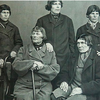

Person attributes


According to their worldview, the eunuchs are close to the whips (Christovers), in terms of rituals - to the Old Believers. As a sect in the religious understanding took shape in the 18th century, the founder is considered to be a fugitive serf Kondraty Selivanov, who left the whip sect of the “Mother of God” Akulina Ivanovna, having become disillusioned with his former religious beliefs. According to the research of Fyodor Glinka, the sect of eunuchs existed from "time immemorial", and in Russia it especially spread during the time of Peter I.
The eunuchs believed that the only way to save the soul is to fight the flesh through castration. In Tsarist Russia, the eunuchs sect was persecuted, its members were exiled to Siberia. The first trial of the sect took place in 1772, when an entire community of 246 people was judged. Despite this, the sect was quite numerous: in the second half of the 19th century, there were about 6,000 eunuchs, mainly in the Tambov, Kursk, Oryol provinces, in Siberia, where rich eunuch communities bought land from the local population.
In the USSR, the sect of eunuchs was banned. In 1929, a high-profile trial of the sect took place. The eunuchs tried to seek support from V. D. Bonch-Bruevich, who spoke in their favor at the trial of 1912 as an expert, but this time they were refused: “... in the 20th century it would be time to stop propaganda of all kinds of self-mutilation from the so-called religious motives". In the second edition of the Great Soviet Encyclopedia, it was noted that in 1947 the sect was still active in the USSR.
In 1971, A. I. Klibanov discovered individual followers in Tambov, and an active community of eunuchs in Rostov-on-Don. It was made up of old people, mostly born before the revolution, but the eunuchs did not abandon attempts to involve young people and middle-aged people in the “ship”. The involvement of "novaks" was carried out by promising material rewards or inheritance, according to a certain scheme:
- The study of family and social ties, character traits, financial situation of a potential candidate.
- Making an acquaintance with a recruiter.
- For 2-3 years, maintaining relations exclusively on non-religious grounds, surrounding the recruited with attention and good deeds.
- Visiting a person scheduled for recruitment at home, by various members of the cult under various pretexts, for further study of the rhythm of life, life and behavior, acquaintances and connections.
- An interview with a proposal to join the "ship" and accept the "seals".
- Approval of the candidate by the local leader of the sect.
According to information received by the scientist from local anti-religious activists, at least in three large cities of the North Caucasus in the 1970s there were skop communities, and the practice of castration continued. The activity of the cult was carried out with the observance of strict secrecy. Klibanov gives a detailed description of the Novak initiation ritual, which includes an oath “not to talk about faith with anyone except brothers and sisters. Neither father and mother, nor kinship, nor friend, nor obvious authority, let the torment, misfortune, not declare this great secret ”. Moreover, for violation of vows, the leaders of the sect openly threatened the followers with reprisal.
There is information about individual communities of eunuchs that existed in the 1990s in Latvia and in Russia (Moscow, Stavropol and the Stavropol Territory, Oryol and the Orel Region). Currently, a small number of eunuchs remain in some areas of the North Caucasus. These are the so-called "spiritual" eunuchs (surgical castration is not performed in their communities). Members of these sects are required to perform a certain cult, to maintain an ascetic lifestyle.
According to Idris Shah, until 1902 only Russians were accepted as eunuchs. The eunuchs proclaimed Napoleon the Antichrist. Among the leaders of the Leningrad eunuchs of the 1920s, the "Protocols of the Elders of Zion" were popular. At the trial, which took place in Leningrad in 1930 , eunuchs were exposed as a monarchist, counter-revolutionary, anti-Soviet sect.
As a separate society, eunuchs were a fairly well-proportioned whole, an organization or corporation with significant capital. They called themselves "white doves" (in contrast to the"gray doves" - whips). The etymology of the self-name is simple: “be whitened” in the jargon of eunuchs means to castrate. The eunuchs, like the whips, called their communities “ships”. Despite the equality of all “brothers” and “sisters” declared by the eunuchs, the “pilot”, who was at the head of the “ship”, had great power over other community members. The woman who helps the "feeder" is called the "Mother of God" in the same way as in Khlyst's practice.
The eunuchs were distinguished by strong proselytism, which was determined by the need to preserve the sect in the face of an almost complete lack of fertility among its members. There were several main ways to involve newcomers in the sect:
- Castration of juvenile relatives
- Economic enslavement
- Redemption of serfs subject to castration
- money seduction
- Propaganda of "purity", especially effective among youth.
Writer Alexandre Dumas, father, during his trip to Russia in 1858 - 1859, who spent three months in the Caucasus and observed the eunuchs there, noted in his travel notes that the eunuchs also had a practice of transferring affiliation to a sect by inheritance - some of the eunuchs castrated themselves only after marriage and the birth of one child. According to Idris Shah, eunuchs had two children.
The circumstance that made it difficult to finally enter the sect was its doctrine of the need for castration, but the eunuchs also supported it with arguments that were difficult to resist. Firstly, texts from the Bible that have a meaning beneficial to eunuchs: in addition to Holy Scripture, eunuchs also looked for expressions and whole phrases that speak of castration in other books of spiritual and moral content, the most common and respected among the people. Secondly, the eunuchs tried to give a strictly religious character to the physical suffering from the operation of castration and persecution by the government. Finally, a leniency was sometimes made, allowing the acceptance of castration to be postponed indefinitely, or at least not obliging one to accept it immediately after joining a sect.
The basis of the teachings of eunuchs was the line from the Gospel of Matthew chapter 19, verse 12:
There are eunuchs who were born like this from their mother's womb; and there are eunuchs who are castrated out of men; and there are eunuchs who have made themselves eunuchs for the Kingdom of Heaven. Who can accommodate, let him accommodate. — Mf. 19:12
The eunuchs also found an indication of the possibility of castration in other quotations from Holy Scripture and Holy Tradition :
- Christ 's indication that it is better to cut off the members that tempt a person than to succumb to temptation ( Matt. 5:29-30, Mark 9:43-47 );
- Apostle Paul 's indications that "those who are Christ's have crucified the flesh with passions and lusts" ( Gal. 5:24 ) and that he himself bears on his body "the ulcers of the Lord" ( Gal. 6:17 );
- Praise of the Lord to the eunuchs of the prophet Isaiah ( Is. 56:4-5 );
- Praise for eunuchs in the book of the Wisdom of Solomon ( Wisdom 3:14 );
- St. Justin the Philosopher in the First Apology, without any condemnation, reports a Christian youth who, circumventing the prohibition on self-castration contained in the 24th Apostolic Canon, asked him to castrate pagan doctors, but they refused him;
- St. Ambrose of Milan, in a letter to Emperor Valentinian II, relates the blessing of the prophet Isaiah to those eunuchs “who castrated themselves by cutting off their reproductive parts”;
- St. John Cassian the Roman, in his work “Scriptures to the Ten Interviews of the Fathers Sent to Bishop Leontius and Ellady, who were in the Skete Desert”, reports how, through the monk’s prayer, an angel tore a piece of flesh out of his loins, after which the monk got rid of carnal passion;
- St. Gregory the Dialogist in his Dialogues tells of a monk who, in order to overcome carnal passion, “threw himself naked on pine needles and nettles, lay in them for a long time, and only when he wounded his whole body did he get up”;
- Lives of the Saints, in which it was indicated that a number of saints (Theodosius of Antioch, Agavva the Ismailian, Evarest Studite, Theodosius of the Caves, Mark of the Caves, Vassian of Tiksna and others) wore chains on their loins , which from a medical point of view was tantamount to slow castration;
- Blessed Theophylact of Bulgaria in his treatise "In Defense of the Eunuchs" writes that castration is not a crime.
The eunuchs strictly observed abstinence from meat food, did not drink alcohol at all, did not smoke, avoided their homelands, christenings and weddings, did not participate in entertainment, did not sing secular songs, did not swear at all. Unlike members of the Old Believer communities, eunuchs willingly attended the Orthodox Church and even showed great zeal in matters of religious rituals. At the same time, they openly ridiculed Orthodox rites and sacraments; the temple was called the "stable", priests - "stallions", worship - "neighing stallions", marriage - "mating", married people - "stallions" and "mares", children - "puppies", and their mother - "bitch, from who stinks and you can’t sit in the same place with her.” Childbearing was called the cause of impoverishment and ruin.
So we don’t get married and we don’t get married, that’s why we are rich. Do the same as we did, stop believing in your stallions, then life will be easier, you will be rich, you will be holy.
Skopskaya Selivanov's song to his "kids":
O beloved children! Now I will reveal the whole truth to you, that I am a redeemer, dear father, henceforth I will arrange whom I will honor for what life and service. To whom I will dissolve the kingdom, and to whom I will give paradise, and to whom I will thank for the faith!
Eunuchs believe that when their number reaches 144 thousand, the Last Judgment will come, followed by the triumph of the followers of eunuchs. "The Last Testament" Selivanov:
Wait for bondage to dissolve soon; wait from hour to hour, so that the merciful father, who saved you alive, would suddenly open in your place.
The eunuchs had their own view of the Gospel (they believed that all the apostles were castrated) and created their own mythology related to their relationship with the Russian tsars. So, according to the fiction of eunuchs, Paul I was killed precisely for refusing to accept eunuchs, and Alexander I, who agreed to castrate, became king. There is an osprey song that recounts a fictitious conversation between Paul and Kondraty Selivanov, after which the fate of the king was decided:
Our Father Redeemer In a meek voice he held: “I would have forgiven Pavlushka: Come back to me Pavel, I would have corrected your life.” And the king answered proudly, He did not notice the Deity, He did not listen and left. Our father, the redeemer, sighed with his heart, waved his right hand: “O earthly slander, In the evening your death! I will choose my servant, the King of God in the circle. And I will give the earthly royal right to the meek king: I will bless Alexander with the whole throne and palaces, He will rule correctly, Do not let the authorities…”
Another legend popular with eunuchs:
Once the senators wake up Alexander I and say to him sullenly: “We heard that you, Your Majesty, are an eunuch. It is no good for the Russian tsar to be an eunuch. Let's go to the Senate, take off your pants there to find out the truth. There was nothing to do, the tsar went to the Senate and there he took off his pants, and everyone saw: yes, he really was an eunuch. The senators got angry and wanted to strangle him there. But at that moment Konstantin, a man of incredible physical strength, also an eunuch, drives up to the Senate and says to the guard: open the gate. He: not allowed to let in. Konstantin snatches the sword from him and cuts off his head with one movement. He runs in and cuts down everyone who turns up by the arm, including the villainous senators. And to the saved Alexander he says:"Oh, you're scared of the chicken."
O. A. Schlesinger in an article in the Encyclopedic Dictionary of Brockhaus and Efron noted:

Man and woman eunuchs with "seals"
In the early days of the existence of skokstvo in Russia, the operation of emasculationin the eunuchs, it consisted in taking (amputating) only the testicles (“udible twins”) with part of the scrotum by annealing with a red-hot iron for the purpose of disinfection. Hence the mystical name: "fiery baptism." Subsequently, eunuchs for the operation of castration began to use various kinds of sharp cutting tools, and red-hot iron - only to stop the bleeding. In this case, the scrotum was previously pulled together above the captured testicles with a thread, braid or rope. The wound was covered with a rag soaked in cold water or smeared with wood oil, descent and other ointments or fresh lard; sometimes, to stop bleeding, the wound was sprinkled with powders of alum, copper sulphate, etc. The wound healed after four weeks - a scar, mostly horseshoe-shaped, that ran across the remaining part of the scrotum. This kind of castration
— Shlesinger O. A. Skoptsy // Encyclopedic Dictionary of Brockhaus and Efron : in 86 volumes (82 volumes and 4 additional). - St. Petersburg. , 1890-1907.
In the province of Kursk, where hoarding was very widespread, there were several cases when the adoption of the "first seal" was carried out independently. The most striking example is the case of self-castration of a prisoner of the Kursk prison castle, who “cut off his core with a razor on the instruction” of another prisoner, who was accused of belonging to the sect of eunuchs.
However, such an operation, without depriving the eunuchs of lust and even the possibility of sexual intercourse, seemed to some insufficient, and they decided to take away the genital member, which was called the “second”, or “royal seal”, “second purity”, “second whitening”, “sit on white horse." It was carried out either together with the removal of the testicles, or later (but not earlier than a few months after the “first seal”, otherwise the probability of death is high), while a tin or lead peg, or a simple nail, was installed in the opening of the urethra, so as not to allow the urethra to overgrow. The wound was healed during the operation in one step with one scar, in the second case - with two scars, which remained with the castrated for life.

A castrated woman who had her breasts removed
There was also a "third seal" - the removal of the nipples, and in some cases the "fourth" - cutting a triangle on the side of the eunuch (the motivation for the rite is unclear, but one could assume, knowing more exactly where exactly the cut was made, that this is a sign pierced by a copy of the rib of Jesus Christ, crucified on the cross (the triangular shape corresponds to the shape of the spearhead)).
Special methods of castration include artificial hypospadias (by artificial ligation of the penis), applied to boys. In the Tambov province, there was a special kind of eunuchs - shifters - who do not deprive themselves of any parts of the body, but, probably, since childhood, twist their spermatic cords. In the sect of piercers, founded by Kutkin, castration was used by cutting or piercing the spermatic cords.
Often , women belonging to the skopsky community were also subjected to "whitening". There were also “seals” for women: they removed the labia, and in some cases also the clitoris and breasts. However, in this case, women did not lose the ability to bear children: the Soviet ethnographer N. N. Volkov, a researcher of the spree, testifies to examples when women who left the community even got married and had children.
On the eve (at night) of some major holidays of the Orthodox Church, eunuchs held meetings of co-religionists in special rooms. At these meetings, special prayers of eunuchs took place - “ rejoicings ”, at which they sang Orthodox chants and skopsky “chanters” or “poems”, received new members of the sect, walked in different ways, while putting on special white clothes, long shirts. The eunuchs also had their own special holidays dedicated to some memories from the life of the founder of the eunuchs Selivanov; for example, September 15 is the day of Selivanov's punishment. On such days, they also arranged rejoicings.
There were four ways to rejoice:

- “boat”: the people who were rejoicing stood in a circle one behind the other and walked in single file one after another, jumping strongly;
- “wall”: the people who were celebrating stood in a circle shoulder to shoulder and walked “salting” (that is, in the sun, from left to right), jumping;
- "cross": 4-8 people stood one or two in each corner and then with a quick step, again jumping, changed places crosswise;
- in “alone”: several people went out to the middle and, to the beat of the quick-spoken “chanters”, began to spin in one place, faster and faster, so that their shirts puffed up and rustled like sails.
These dances, which the eunuchs indulged in to the point of stupefaction, exhausted their strength, which, according to the eunuchs, weakened the "evil nonsense"; and on the other hand, they acted on those who were glad, as if narcotic, giving them a special kind of pleasure and joy.