Other attributes
A metaverse economic zone is a cross-border special economic zone (SEZ) based in the metaverse. The purpose of a metaverse economic zone tends to be developing a digital space where businesses can operate across borders, through legally-compliant and interactive environments, and can cater to multinational corporations, decentralized autonomous organizations, and individuals. This can help a country or organization grow in the developing digital economy. As well, the goal of a metaverse economic zone can be to build a framework for corporations to develop Web3 marketing, work reform, and consumer experience initiatives.
The concept of the metaverse economic zone comes from the rise of the metaverse as a potential technology for establishing a new virtual world where people can work, play, and meet each other without leaving home, blur the lines between reality and virtual life, and redefine the way people consume and communicate, which requires or creates an opportunity for the creation of a new, virtual economy.
Often the metaverse economic zone is part of Web3 development and is based on blockchain technology, which allows the metaverse economic zone to be decentralized and with the various pieces and modules through the zone to be owned by the builders, users, and creators of those modules. The metaverse economic zone is ultimately an ecosystem resulting from the interoperability of different metaverse systems and platforms available to consumers.
The metaverse has long been discussed as having the ability to connect technology and finance, with the metaverse offering a concept that can unionize global trends toward what some describe as a futuristic and innovative approach where users and organizations have decentralized opportunities in a virtual ecosystem with an aim to boost finance and without need for government institutions and intermediaries.
There has been an attempt by companies and organizations already involved in developing metaverse-based products, services, and technologies, have led to an attempt to create an open metaverse infrastructure allowing for interoperability with an ability to port assets and characters across multiple virtual worlds developed and run by different interests. This has led to the development of the Open Metaverse Alliance (OMA3), which is supposed to be governed by a DAO and has been progressing in development since 2021. OMA3 has been working to establish standards between metaverse platforms, legal protections in Web3, and developing standards to push the internet into the direction of the metaverse while also working antagonistically against corporations that have tried to define the metaverse space.
Another group working to develop an open metaverse is the Metaverse Standards Forum, backed by the Khronos Group among other technology groups. This group is approaching it through attempting to develop and push the adoption of blanket rules for the growing online space to help in the adoption of these spaces and the interoperability of these spaces, especially in the sense of the behavior of users and organizations. Members of the organization include Google, Meta, Microsoft, Nvidia, Web3D Consortium, Adobe, Autodesk, Epic, and Accenture.
According to the developers, the metaverse-based special economic zone (SEZ) was developed by MSEZ, a regulatory technology firm. Launched in late 2022, the SEZ is a multi-jurisdictional special economic zone developed to allow users—individuals, organizations, and companies—to operate seamlessly across borders, through the technology of the metaverse. The metaverse-based SEZ is developed to offer users unrivaled tax concessions, an interactive metaverse environment, access to multiple special economic zones, digital regulations, knowledge clusters, and an infrastructure targeted to decentralized autonomous organizations (DAOs), digital nomads, and e-commerce platforms. Anguilla, an associate member of the Organization of Eastern Caribbean States, is the first jurisdiction in the MSEZ.
The Japan Metaverse Economic Zone (JMEZ) was announced on February 16, 2023. JMEZ is a preliminary agreement between several Japanese firms as part of a bid to improve the country's digital economy. The group is expected to develop JMEZ in two phases. The first phase, scheduled to begin in April 2023, involves developing the underlying technological infrastructure to develop the virtual world; the second phase, set to commence in 2024, focuses on creating the virtual world itself. The firms involved in the agreement, and their respective roles, include the following:
- JCB Co., Ltd.—functions and expertise in MMP/ID authentication and building a digital twin for merchants
- Mizuho Financial Group, Inc.—functions and expertise in the MMP/payment area, provide Metaverse coins, and regional DX collaboration
- Sumitomo Mitsui Financial Group, Inc.—gamification promotion, PWK development support, and creator economy building
- Mitsubishi UFJ Financial Group, Inc.—support in establishing MMP functions (authentication/settlement/data), Web3-type metaverse financial functions, and overseas expansion
- Resona Holdings, Inc.—joint research in future lifestyles and next-generation ID authentication and payment
- Sompo Japan Insurance Inc.—risk analysis and insurance development for the Web3 Era, including the metaverse
- Toppan, Inc.—interoperation of the MiraVerse metaverse platform and the AVATECT avatar generation and management platform and expertise in handling cultural content and expressive technology
- Fujitsu Ltd.—Web3-related technologies, such as digital data rights management
- Mitsubishi Corporation—global partner to expand overseas and economic sphere of the metaverse platform
- TBT Lab Inc.—gamification functions and expertise, and provide PWK and MMP

The companies working to develop the Japan Metaverse Economic Zone.
The infrastructure is developed with the intent of establishing an open metaverse to propel Japan's Web3 strategy and creating a framework in which corporations can develop Web3 marketing, work reform, and consumer experience initiatives. To achieve this, the member companies are developing an interoperable metaverse structure called RYUGUKOKU. Part of this plan is to meet the growing demand for digital transformation (DX) in the virtual domain for enterprises and government agencies. The resulting metaverse is expected to serve as a new social infrastructure for enterprise DX as well as consumer DX and consumer experience transformation (EX).
The idea for the initiative is part of Japan's government's digital transformation plans, and to update Japan through the power of games. Part of this plan has included promoting Web3 services and investments for digital transformation. Japan has also established a Web3 policy office under the Ministry of Economy, Trade, and Industry and is part of Prime Minister Fumio Kishida's drive to adopt Web3 technology.
The project includes the firm using individual expertise to develop a metaverse infrastructure for enterprises and individuals called RYUGUKOKU, although that is considered a working name. RYUGUKOKU is expected to be designed as a virtual world with elements of a role-playing game (RPG) with services such as cities or vehicles, while users in the virtual world can roam in search of various experiences.
At the same time, RYUGUKOKU is anticipated to give businesses a chance to share information, transform work styles, and market their services and products. The virtual infrastructure is being built to include secure identity credentials, insurance, payments, and secured data. Areas of focus for RYUGUKOKU will include interoperability, gamification, financial technology (Fintech), and information communications technology (ICT). The infrastructure is also developed to be open, with what some call an Open Metaverse Infrastructure, intended to enable interoperability between different platforms and to serve as a new social infrastructure.

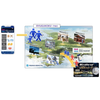
Image of the expectation of the RYUGUGOKU metaverse and the surrounding technologies to enable the adoption of the metaverse.
RYUGUKOKU is also expected to implement "auto-learning avatars," which work to collect users' information and provide a personalized metaverse experience. The auto-learning avatar uses a digital twin to better learn about the user and provides personalized information on health care, hobbies, and other topics. A user is able to acquire information through their avatar and will apply their personalized information in each metaverse space.
The "multi-magic passport" (MMP) provides identification and payment methods to help facilitate interoperability within the metaverse space. The MMP will also allow users to move their personal data, including their avatar status and memory, items, and non-fungible tokens (NFTs) between compatible metaverses. This is intended to make the combination of services attractive to other companies. MMP is a combination of unique identification and wallet service. This is intended to improve user-friendliness through the different metaverse environments and in the real world.
The development of RYUGUKOKU will use the metaverse construction framework Pegasus World Kit (PWK) developed by TBT Lab Group and owned by JP Games. The Pegasus World Kit is an advanced tool for creating metaverse services and game services, enabling users to construct entertaining and experience-oriented systems. The tool is also developed to be scalable for users, with various functions—such as an "RPG Editor"—intended to create game events and help create new metaverses.
Through RYUGUKOKU, each service and content presented is expected to take on the form of a moving "city," "castle," or "vehicle" that roams around the virtual world. The individual users are then enabled to engage in an RPG-like experience while they travel through the different metaverses or realms and encounter a variety of contents and services.