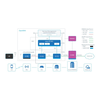


xApps are applications, in some cases developed by third party specialist software providers, which run on the RAN intelligent controller. These applications can run on near-real time RAN intelligent controller software platforms, where they act as a key enabler for innovation in the Open RAN software ecosystem. These applications can offer utility such as mobility management, admission control, and interference management, and act as plug-ins for the controller and enforce their policies via southbound interface towards base stations.
The near-real time RAN intelligent controller operates as a cloud-based process on a network edge capable of handling events requiring action from 10 milliseconds to 1 second. The near-real time RAN intelligent controller provides policy guidance to non-real time RAN intelligent controllers through xApps.
Hosting the microservice-based applications, referred to as xApps, allows the near-real time RAN intelligent controller to enhance the RAN's spectrum efficiency. Within the structure of the near-real time RAN intelligent controller, xApps communicate via defined interface channels. Through an internal messaging infrastructure, it provides the framework to handle conflict mitigation, subscription management, app lifecycle management functions, and security.
For example, in a successfully tested RIC configuration between Nokia and AT&T, xApps were used to collect measurement and optimization data on the live network during the trial.
Some see the inclusion of xApps, and the related rApps, as a chance to change the experience of service providers for networks, with some comparing the xApps and rApps to mobile apps and the change mobile apps made to the mobile phone computing ecosystem.
For example, xApps can create a kind of market in which the xApps can allow a network to do different things, such as controlling the flight path of an unmanned aerial vehicle. Or they could offer the chance to control a network's performance based on specific characteristics, such as changing the performance during a rainy day.
This capability has drawn the interest of various telecommunication companies and development communities, as they offer a new opportunity for a wider ecosystem to join the market segment.