Other attributes
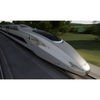
It is a maglev (magnetic levitation) line using partly evacuated tubes or tunnels. Reduced air resistance could permit vactrains to travel at very high (hypersonic) speeds with relatively little power—up to 6,400–8,000 km/h (4,000–5,000 mph). This is 5–6 times the speed of sound in Earth's atmosphere at sea level.
21st century
James R. Powell, co-inventor of superconducting maglev in the 1960s, has since 2001 led investigation of a concept for using a maglev vactrain for space launch (theoretically two orders of magnitude less marginal cost than present rockets), where the StarTram proposal would have vehicles reach up to 14,300 to 31,500 km/h (8,900 to 19,600 mph) within an acceleration tunnel (lengthy to limit g-forces), considering boring through the ice sheet in Antarctica for lower anticipated expense than in rock.
ET3 claim to have achieved some work that resulted in a patent on "evacuated tube transport technology" which was granted in 2009. They presented their idea 2013 on public stage.
In August 2013 Elon Musk, CEO of Tesla and SpaceX, published the Hyperloop Alpha paper, proposing and examining a route running from the Los Angeles region to the San Francisco Bay Area, roughly following the Interstate 5 corridor. The Hyperloop concept has been explicitly "open-sourced" by Musk and SpaceX, and others have been encouraged to take the ideas and further develop them.
To that end, a few companies have been formed, and several interdisciplinary student-led teams are working to advance the technology. SpaceX built an approximately 1-mile-long (1.6 km) subscale track for its pod design competition at its headquarters in Hawthorne, California.