Other attributes
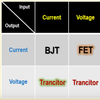
The theoretical component has been proposed by Sungsik Lee, Professor, Department of Electronics Engineering, Pusan National University in 2018. It is proposed that a trancitor in combination with a transistor might form more efficient circuits, reducing circuit complexity and increasing power efficiency. The trancitor is an active device with an inverse functionality of transistors, which would directly transfer an input signal into a voltage output. Whereas a transistor, such as the bipolar junction transistor (BJT) or field-effect transistor (FET), works by taking the input signal that is then transferred into the current at the output, and works like a variable resistor.

Theoretical list of elementary devices from 4 possible combinations of current and voltage at input and output.
The term trancitor is the combined word of a "transfer-capacitor" and can be considered as another category beside the transistor, which works as a transfer-resistor. The initial proposal of the trancitor was based on the theoretical recognition of two missing devices, those of the transfer-capacitor variety, including current-controlled voltage source (CCVS) and voltage-controlled voltage sources (VCVS) devices. The use of either of these device would provide a voltage output without a sophisticated load circuit, and, hence, the expected power-consumption gains and reduce circuit complexity.
Finding a trancitor could offer a new paradigm of electronics, and lead to low complexity, low-power devices with higher possible operating speeds at the circuit level compared to transistor-only circuits. Furthermore, this paradigm could be an essential part of future electronics, such as thin film electronics and wearable and neuromorphic systems.
The theory of a trancitor also suggests a way to go beyond CMOS electronics. Sungsik Lee suggests the new device could go beyond CMOS electronics by employing the Hall effect, which works by producing voltage when a magnetic field is applied in a perpendicular direction to the current. Sungsik Lee has also suggested that the current transistor technology, which has been optimized for smaller scale and higher performance and requires higher integration density for down-scaling until it reaches a physical limitation and has caught up with Moore's law. Whereas the concept of the trancitor coupled with transistors can help meet Moore's law.


