
Etymology
The Latin name of the genus comes from other-Greek. ποος — bux, boxwood, borrowings from an unknown language. The etymological dictionary of Fasmer derives the word boxwood from the Persian word šimšäd. Perhaps from the Adyghe hemshutl - boxwood.
In the "Explanatory Dictionary of the living Great Russian language" other Russian names of boxwood are given — bux, zelenichye tree, gevan, bukspan, shamshit [6], as well as palm (possibly from the Netherlands. Randpalm): "it is known in turning crafts under the name palm trees, having been brought to us under Peter by the Dutch, who make folding yards or feet of their palm trees out of it."
Botanical description
Boxwood is evergreen. Botanical illustration from the book by O. V. Tome Flora von Deutschland, Österreich und der Schweiz, 1885
The leaves are opposite, from elliptical to almost rounded, whole-edged, leathery.
The flowers are small, unisexual, in axillary inflorescences, fragrant. The fruit is a three-nest box, which cracks when ripe and scatters black shiny seeds.
Distribution and ecology
Boxwoods are very unpretentious plants: they grow on rocky scree, on the edges of forests, in shrubby thickets and dark deciduous forests. Very shade-tolerant, but also thermophilic. In nature, they live on slightly acidic soils.
Boxwood is often mentioned by ancient authors. According to Ovid, the ancient Greek goddess Athena made herself a flute from boxwood.
There are three major ranges:
African — in forests and forest-steppes south of Equatorial Africa and Madagascar,
Central America — in the tropics and subtropics to the South of Northern Mexico and Cuba (25 endemic); American types — the large-leaved plants of the genus, often reaching the size of trees of medium size (up to 20 m),
Euro-Asia — from British Isles via southern Europe, Asia and West Asia, the Caucasus, China to Japan and Sumatra.
In Russia
In Russia, on the Black Sea coast of the Krasnodar Territory and the Caucasus, in the gorges and valleys of rivers in the second tier of broad—leaved forests, one species grows - Boxwood Colchis (Buxus colchica). Colchis boxwood is listed in the Red Book of the Russian Federation.
The unique boxwood forest is located in the middle reaches of the Tsitsa River on the territory of the Tsitsinsky forestry of the Kurdzhipsky forestry in the Republic of Adygea, has the status of a site with a protected protection regime. Its area is about 200 hectares.
There is a boxwood grove in the city of Sochi (Matsesta microdistrict of Khostinsky district), on the outskirts of the main road of Kurortny Prospekt) and in Abkhazia near the city of Pitsunda, on the way to the non-working boarding house "House of Cinematographers' Creativity". In Abkhazia, there is a phraseological phrase "even boxwood does not remember": this is how they talk about events that happened a long time ago.
The area of boxwood in Russia is constantly decreasing due to logging. Especially large areas of boxwood relic forests suffered in the fall of 2009 during the construction of the Olympic road Adler - Krasnaya Polyana. Several thousand trunks were uprooted and buried. In addition, boxwood firewood, a dangerous invasive pest, was imported with planting material for Olympic construction projects, as a result of which the Yew-boxwood grove and other boxwood plantations in the Caucasus are under threat of complete destruction. According to the environmental organization "NABU-Caucasus" as of August 2017 There are only 5.5 hectares left in Russia. boxwood forests[10].
In Sochi, 99% of boxwood has died since 2012, it will take ~ 300 years to recover. Previously, 4-4.5 thousand trees grew on the hectare, now it is empty.
Meaning and application
Rietveld, een buurtschap tussen de velden met buxus en heel veel meer.jpg
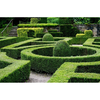
Boxwood is one of the most ancient ornamental plants that were used for landscaping and in decorative gardening (often called "Buxus"). It is valued for its thick, beautiful crown, shiny foliage and the ability to tolerate haircuts well, which allows you to create hedges and borders from them, as well as bizarre shapes that retain their shape for a long time (see Topiary).
Catholics in Western Europe, as well as Orthodox Christians in Georgia, decorate their homes with boxwood branches on Palm Sunday.
Boxwood is an excellent honey plant that gives early bribes (on the Black Sea coast — in late February - early March), although honey from it is considered poisonous.
Wood
The white figures are made of boxwood
Boxwood is a non-core ripe wood breed. This means that in a freshly cut tree, the difference in color between sapwood and ripe wood is almost imperceptible. Dried boxwood wood has a uniform matte color from light yellow to waxy color, which darkens little with time, and a uniform structure with narrow annual layers. The vessels are small, solitary, not visible to the naked eye. The core rays are almost invisible on the incisions. The wood tastes a little bitter, there is no special smell.
The wood of boxwood is the hardest and densest of all found in Europe. Its density ranges from 830 kg/m3 (absolutely dry) to 1300 kg/m3 (freshly cut), and its hardness ranges from 58 N/mm2 (radial) to 112 N/mm2 (end).
The strength of boxwood is superior to hornbeam: compression along the fibers - about 74 MPa, with static bending - 115 MPa.
Solid, homogeneous, heavy boxwood wood is used for small woodcarving, in the manufacture of small dishes, chess pieces, cue balls for playing novus, musical instruments, sculptural stacks, machine parts that required high wear resistance in combination with a perfectly smooth surface: rollers of printing machines, spools and weaving shuttles, measuring instruments, parts of optical and surgical instruments. Svilevatye areas are used for the manufacture of smoking pipes.
Boxwood sawn across the fibers (end) is used in woodcut (woodcut). Boxwood is the best wood for woodcuts, and this led to its almost complete destruction in the second half of the XIX century, when illustrations in newspapers around the world were cut on boxwood boards, sometimes the size of a newspaper spread.
From boxwood, sawn veneer was made and is now being made in small quantities, using special machines with a thin cut. In the XX and XXI centuries, boxwood veneer is used only for inlays due to its high cost.
Tsuge (Japanese name for small-leaved boxwood) is the wood used to make figures for playing shogi.
Offers to sell boxwood on the market are quite rare, and its price is very high.
Medicine
Already in ancient times, boxwood was used as a medicinal plant as a remedy for cough, gastrointestinal diseases, as well as chronic fevers, for example, malaria. As a remedy against malaria, allegedly, comparable in action with quinine. Nowadays, boxwood preparations are rarely used because of their toxicity, since they are very difficult to accurately dose. Overdose can lead to vomiting, convulsions and even leads to death. Homeopaths still use boxwood as a remedy for rheumatism.
Toxic properties
All parts of the plant and especially the leaves are poisonous. Boxwood contains about 70 alkaloids, among others cyclobuxin D. In leaves and bark, the alkaloid content is about 3%. The lethal dose of cyclobuxin D for dogs is 0.1 mg per kilogram of body weight when taken orally.
Reproduction
Dry opened boxwood fruits
In nature, boxwood propagates by seeds and vegetatively.
In culture, it is usually propagated by summer and autumn cuttings, since the seeds have a very long dormant period.