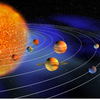

The total mass of the Solar System is about 1,0014 M☉. Most of it falls on the Sun; the remaining part is almost completely contained in eight planets distant from each other, having orbits close to circular, lying almost in the same plane — the plane of the ecliptic. Because of this, there is a contrary to the expected distribution of the angular momentum between the Sun and the planets (the so-called "problem of moments"): only 2% of the total moment of the system is accounted for by the Sun, whose mass is ~ 740 times greater than the total mass of the planets, and the remaining 98 The four planets closest to the Sun, called the terrestrial planets - Mercury, Venus, Earth[19] and Mars - consist mainly of silicates and metals. The four planets farther from the Sun - Jupiter, Saturn, Uranus and Neptune (also called gas giants) - are much more massive than the terrestrial planets.
The largest planets in the Solar System, Jupiter and Saturn, consist mainly of hydrogen and helium; the smaller gas giants, Uranus and Neptune, in addition to hydrogen and helium, contain methane and carbon monoxide in their atmospheres[20]. Such planets are allocated to a separate class of "ice giants" % is ~0.001 of the total mass of the Sol
ar System. Six of the eight planets and four dwarf planets have natural satellites. Jupiter, Saturn, Uranus and Neptune are surrounded by rings of dust and other particles.
There are two regions in the Solar System filled with small bodies. The asteroid belt located between Mars and Jupiter is similar in composition to the planets of the terrestrial group, because it consists of silicates and metals. The largest objects of the asteroid belt are the dwarf planet Ceres and the asteroids Pallas, Vesta and Hygeia. Beyond the orbit of Neptune are trans-Neptunian objects consisting of frozen water, ammonia and methane, the largest of which are Pluto, Sedna, Haumea, Makemake, Quavar, Orc and Eris. There are other populations of small bodies in the Solar System, such as planetary quasi-satellites and Trojans, near-Earth asteroids, centaurs, damocloids, as well as comets moving through the system, meteoroids and the space system


