
History of origin
Yoshta is the result of many years of work of several generations of breeders who worked on crossing black currant and gooseberry. Scientists have tried to improve the currant by the following parameters: to increase the size of berries and yield, as well as to instill resistance to kidney mite and terry. At the same time, it was desirable to get rid of gooseberry thorns when crossing.
The first experiments were undertaken by I. V. Michurin, who developed the theory of crossing distant forms of plants, in particular, currants and gooseberries. But hundreds of attempts by breeders from different countries did not lead to success: hybrids either turned out to be unviable or infertile.
German specialists from the Max Planck Institute have made the most progress in crossing currants and gooseberries. For forty years they have been working on remote hybridization, and finally, in the 1970s, the first results were obtained. According to some reports, fruiting hybrids were obtained through the use of methods of radiation and chemical exposure.
By 1989, yoshta was fully ready for industrial use.
The hybrid was brought to Russia (USSR) in the early 1980s, cultivated by gardeners since 1986.
At the beginning of the XXI century, other hybrids of gooseberries and black currants are also known: a hybrid of T. S. Zvyagina (USSR), Krondal (USA), krom (Sweden), rike (Hungary). They all have a lot in common, but they differ significantly in the shape of the bush, size, weight and taste of berries, as well as winter hardiness and yield.
For example, an American hybrid named after the scientist Krondal looks more like a gooseberry, with the same leaves and the shape of a bush; at the same time, the berries are black, like currants, and with a similar taste. Swedish chrome is obtained by crossing gooseberries with currants of the Karelian variety; it is a fast-growing, very productive hybrid with branches thick, like a real tree. The fruits in the first half of summer taste like gooseberries, in the second — currants.
Biological description
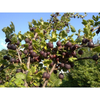
Yoshta is a perennial berry shrub. The bushes are powerful, spreading. They grow rapidly, forming shoots with a height of 1.5 m or more. Unlike gooseberries, they do not have thorns. On average, a fruiting bush consists of 15-20 large branches of different ages. The crown diameter is about 1.5-2 m. The root system lies at a depth of 30-40 cm .
The leaves are dark green, large and shiny, without a pronounced currant flavor. Fall late in autumn.
The flowers are large and bright.
The berries are black with a purple tint. Usually collected in a brush of 3-5 pieces. They are distinguished by their dense skin, and they are similar in size and shape to cherries. The taste is sweet and sour, with a pleasant nutmeg flavor. The average weight of the fruit is about 3 g, although individual berries can reach 5 g. When fully ripe, they do not crumble.
The peculiarity of the plant is resistance to certain diseases and pests. Resistant to winter frosts. Life expectancy is about 20-30 years.
Yoshta is widespread in Western Europe.
Yoshta varieties
EMB - resistant to diseases and insects, tall — up to 1.8 m tall - a variety of British breeding, inherited to a greater extent the characteristics of gooseberries. The flowering of yoshta of this variety lasts about 2 weeks, fruiting is abundant, berries weighing up to 5 grams of excellent taste are ripe for about two months;
The crown is a Swedish variety, of medium yield, the berries of which are not large in size, but they do not fall off after ripening, but stay on the bush for a long time. This variety is often used for hedges and for landscaping;
Rext is a frost-resistant, high-yielding Russian variety with not very large berries weighing up to 3 grams of excellent taste qualities;
Yohini is a highly productive variety, reaching 2 m in height, with very sweet berries that taste a little like both gooseberries and currants;
Moro is a plant reaching a height of 2.5 m, with dark, almost black fruits the size of a cherry, with a purple bloom and a strong nutmeg aroma. Yoshta Moro belongs to the new, so-called columnar varieties — compact, but tall.
Cultivation and agrotechnics
Yoshta is mainly planted as an ornamental plant. For decorative hedges, plants are planted at a distance of 35-45 cm from each other (as part of mixed borders 0.7-2 m from other individuals). It is desirable to shape single bushes.
To obtain a stable harvest, the plant is planted in an open, well-lit area. The soil should be loose, rich in organic substances, potassium, well moistened.
Yoshta is planted in spring or early autumn (according to some sources, in late August - early September). They are fed with the same fertilizers as gooseberries and currants. The bush practically does not require pruning, is resistant to diseases and temperature changes.
Yoshta grows very quickly and begins to bear fruit already in the second or third year. The average yield is 7-10 kg of berries from one bush.
Yoshta is propagated by lignified cuttings and root offspring.
Using
In medicine
The vitamin C content in yoshta is lower than that of currants, but 2-4 times higher than that of gooseberries (on average 90-100 mg per 100 g of berries). In addition, yoshta contains a large amount of vitamin P and anthocyanins. The fruits have high medicinal properties - they increase the level of hemoglobin in the blood, contribute to the acceleration of metabolic processes, and are also used in the treatment of gastrointestinal diseases.
In the household
The berries ripen within 2-3 weeks. Collected in small brushes, they keep up at different times. It is recommended to process at the end of July, when the fruits reach biological maturity. The ratio of sugar and acidity in ripe fruits is on average 0.8 higher than that of currants, and 0.3 higher than that of gooseberries.
Yoshta berries can be consumed both fresh and processed.
It is recommended to take half-ripe berries for jam (they do not boil, keeping their shape).
Ripened fruits are frozen, juices, fruit drinks, compotes, jam, jam, jelly, confections are made from them. These products are prepared in the same way as from ordinary currants.


