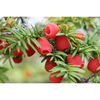

Berry yew, also berry yew, zelenitsa, negniyuchka, negnoy, mahogany is a species of trees of the genus Yew of the Yew family (Taxaceae). The height is 10-20 m, in some cases up to 28 m. It grows slowly, while it has a long life expectancy — according to various authors, from 1.5 to 4 thousand years. One of the oldest in Europe is the Fortingale yew growing in Scotland, under the shadow of which, according to local legend, Pontius Pilate's childhood years were spent.
Distribution and habitat
It grows in Western, Central and Southern Europe (in the north it reaches western Norway, where the world's northernmost natural habitats of the Yew genus are located), in southern Sweden and the Aland Islands, in northwest Africa, northern Iran and southwest Asia.
On the territory of Russia it is found in the western part of the North Caucasus (Caucasian Nature Reserve, Yew-boxwood grove). Individual specimens and groupings of yew are found in the Kaliningrad Region, Belovezhskaya Pushcha (Belarus), in the western regions of Lithuania, Latvia and Estonia, in the Carpathians and Crimea (Chatyrdag, Belbek Canyon).
It grows in forests (in stands and undergrowth), on plains. In the mountains it rises to a height of 2000 m above sea level.
Biological description
Botanical illustration from the book by O. V. Tome Flora von Deutschland, Österreich und der Schweiz, 1885
The tree is up to 27 m tall and 1.5 m in diameter, with an ovoid-cylindrical, very dense, often multi-vertex crown, the bark is reddish-gray, smooth or lamellar. The buds are rounded or oval, blunt, light brown, with few scales. The trunk is abundantly covered with dormant buds, which can give rise to lateral shoots. The leaves (needles) are 20-35 mm long, 2-2.5 mm wide, slightly curled along the edge, glabrous, dark green above, shiny, with an obvious middle vein, pale green below, dull.
Anther cones are solitary, in leaf axils (needles), microsporophylls with 2-8 sporangia each. The seed cones are solitary, have one straight ovule surrounded by a roof (arillus), which grows with seeds into an annular, fleshy, bright crimson, sweet-tasting roller. Seeds are hard, oval, brown. Pollination in April-May.
All parts of the plant, with the exception of arillus, are poisonous.
Economic significance and application
Male cones of yew berry
Transverse cut of a 27-year-old berry yew with a pronounced core
Yew Maze at Chenonceau Castle
Mature yew seeds with bright seedlets
The bark is suitable for making glue for catching birds.
Leaves can serve as bioindicators of heavy metals in the air of cities.
Chemical composition. Toxicity
The wood, bark and leaves of yew contain terpenoids (including taxol, baccatins (baccatin III, 10-Deacetylbaccatin) and taxin), steroids (sitosterol, campesterine), cyanogenic compounds (taxifylline), lignans, tannins, phenols and their derivatives, vitamins, flavonoids, anthocyanins, higher fatty acids and higher aliphatic alcohols. The seeds contain alkaloids (0.92%), and the fleshy seeds (rooflets) contain 16.3% carbohydrates.
All parts of the plant, except the seed roof, are poisonous.
Taxin [en] causes severe irritation of the mucous membranes of the digestive tract, accompanied by vomiting and diarrhea; significantly affects cardiac activity (causes arrhythmia and bradycardia), stops breathing. There have been cases of poisoning of various groups of domestic animals (horses, cattle, pigs, sheep, chickens), as well as wild goats. However, pine cones are harmlessly eaten by birds, martens, etc., and yew undergrowth by wild ungulates. Poisoning of livestock is possible when eating cut branches after cutting yew. A single lethal dose of green branches is equal (in g): for horses 150-400, cattle - 500, for sheep - 150-200, for goats - 500, pigs - 75-100. Milk when eaten by lactating yew animals becomes poisoned, causing diseases of suckling young. LDmin of the taxin alkaloid for humans is 3 mg/kg.
Poisoning of a person is possible if poisonous seeds get inside. Symptoms of human poisoning: nausea, vomiting, diarrhea, general weakness, abdominal pain, drowsiness, convulsions, suffocation, cardiac dysfunction, resulting in a state of collapse and death. A fatal outcome may occur within the first hour or within a few hours (or the first days). Pliny the Elder in "Natural History" testifies to cases of poisoning of a person who drank wine from a yew cup. The older the needles of the yew, the more poisonous it is.
Wood
Main article: Yew (wood)
The wood is durable, hard, elastic, heavy, does not rot, is valued for its beauty and color (yellow-red or brownish-red, changing to purple-crimson in water), darkens over time and becomes like ebony. It is used in construction, carpentry and turning, for finishing furniture and musical instruments, in the form of plywood.
Berry yew, which originally occupied a very large territory, was almost completely exterminated by man because of its durable and almost "eternal" wood, which has strong bactericidal properties — it kills even those microorganisms that are in the air. A house in which at least the ceiling beams are made of yew is reliably protected from pathogenic infection, which was extremely appreciated during mass epidemics.
In ancient Egypt, sarcophagi were made of yew.
Due to the combination of "survivability" and viscosity of wood, yew was one of the best materials for making bows. For example, medieval English longbows were made of yew, which are considered the main weapon with which the British won victories in the Hundred Years' War.
Wood is used for ascites, locally (in the form of sawdust) - for bites of rabid dogs.
Application in parking construction
Yew is a valuable park tree. So, this tree was often used to create mazes in French parks, large yew bosquettes and lattices are available in Versailles. One of the three existing yew forests in Europe is located in the Killarney National Park in Ireland.
Yew is usually propagated by cuttings. Cuttings taken from branches directed upwards give bushes with compact vertical growth, and cuttings from horizontal branches, taking root, form spreading low plants.
Application in medicine
In Avicenna's treatise "The Canon of Medical Science" (1021), berry yew is presented as a phytotherapeutic agent used for heart diseases.
Berry yew is used in classical homeopathy.
Since the 1990s, yew tree alkaloids (taxanes) have been used for the manufacture of antitumor agents (paclitaxel, docetaxel).
Taxol in the experiment has cytotoxic, antileukemic and antimitotoxic properties, is used for research purposes. Taxin in the UK is used in chemotherapy for ovarian, breast, rectal, and skin cancers.
Branches and leaves in Indian medicine are used as a cardiotonic, antispasmodic, expectorant, for flatulence, epilepsy, bronchial asthma, bronchitis, diarrhea; in folk medicine — for women's diseases, amenorrhea, decoction of leaves as a stimulating regula, anthelmintic, and externally — for scabies, infusion — for croup, sore throat; in homeopathy, leaf essence — for rheumatism, gout, diseases liver, kidneys, heart, constipation, erysipelas, pustular dermatitis.
A decoction of seeds acts on the heart in a similar way to that of foxglove.
Fleshy seeds in Indian medicine are used as a tonic, gastric, expectorant, for flatulence, fresh juice as a diuretic, laxative, syrup - for lung diseases, ascites, hemorrhoids, jelly - for chronic cough, whooping cough, kidney stones