
Person attributes


William Thomas Green Morton was born on August 9, 1819, in Charlton, United States. He grew up in the family of farmers James Morton and Rebecca Needham. In 1827, in order for the boy to attend school, his family moved to North Charlton. While still at school he showed an interest in medicine and often spoke with the local doctor, who in no way encouraged the boy's aspirations to the medical profession, but rather cooled his dreams, referring to his own hard, thankless work.
At school, Morton shunned association with his classmates and was often sequestered in his search for and collection of minerals. He did not abandon his dreams of a career as a doctor, but at the time he was to begin his medical education, his father went completely bankrupt. The young man tried to open his own business, but because of his lack of experience in life he could not succeed, being constantly tossed from one occupation to another. After working a little in Boston in a publishing company, he returned home and began to conduct business in his father's shop. Dreaming of becoming a large and independent merchant, began to carry out various financial and trading operations, but soon finally collapsed not only his projects, but his father's business.
Then William Morton returned to his dreams of a medical profession and in 1840 enrolled in the newly opened dental school in Baltimore. After receiving his diploma, for two years he carried on his practice in the small towns of Farmington and Geshire, Connecticut. Having absolutely no practical experience at all, he decided to take at least some practical training from a more experienced dentist to begin with. That's how he met self-taught dentist Horace Wells.

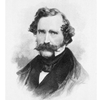
William Morton in his youth
The young men agreed to open a dental business together in the huge nearby city of Boston. Wells had a proven track record of practice and experience, while Morton had a completed specialist education and, in addition, a secret about dentures and crowns. Both companions were confident of success and anticipated imminent enrichment. Money was needed to rent space in Boston and to acquire the physical facilities. Dentists were able to convince an elderly lady to lend them a thousand dollars to open an office. They did not skimp on the necessary advertising and diligently published ads in newspapers about the new method of dental crowns, promising to return the money to those who were dissatisfied with their work.
The ads worked reliably, and hundreds of patients climbed the stairs to the second floor of their joint office. But almost the entire stream of clients soon came back down after learning that dentures must inevitably be preceded by the excruciating extraction of all the dental stubs left behind by other dentists. Business went badly, and about a year later, in November 1843, Wells wrote a letter to Morton informing him of his withdrawal from the joint venture due to unprofitability.
William Morton, left alone, stubbornly sought new clientele, diligently perfected his prosthetic technique, successfully applied the intermediate putty he had invented, and methodically sought all sorts of different methods of anesthesia. His business gradually improved, and in another year he was able to pay off his creditor in full. Soon he entered Harvard Medical School. He studied medicine while continuing his dental practice as a means of living. He also set up a workshop for making artificial teeth, where the work was done by the conveyor belt method.
Morton's main goal was to find a means of reliable pain relief, both in dental extractions and in the treatment of teeth for dentures. Charles T. Jackson, a recognized physician and scientist, suggested that he use ether. The dentist began to experiment with it - first on animals and then on himself. Finally, on September 30, 1846, the great opportunity came to test the ether on a patient. A man named Eben Frost entered the office, suffering from terrible toothache, and wished to use anything to alleviate the suffering of an extraction. The dentist applied ether and removed the sore tooth. When Frost regained consciousness, he said he felt no pain.

William Morton performs surgery
Although the operation took place in front of witnesses and was reported in the Boston newspapers the next day, the event did not attract widespread attention. William Morton asked Dr. John Warren, senior surgeon at Massachusetts General Hospital in Boston, to give him an opportunity for a practical demonstration--in front of a group of doctors--of his method of pain management. Dr. Warren agreed, and the demonstration was scheduled at the hospital for October 16, 1846. Before a considerable audience of doctors and medical students, Gilbert Abbott's patient was sedated with ether, and then Dr. Warren removed a tumor on his neck. The anesthesia proved completely effective, and the demonstration was a resounding success.
A few days after Abbott's surgery, Morton and Jackson filled out a patent application. Although the patent was issued to them within a month, the result was not without a series of fights over priority. Morton's claim that the main glory of introducing anesthesia belongs to him was disputed by a number of people, especially Jackson. Moreover, the hope that the innovation would make him rich did not materialize. Most of the doctors and hospitals that used anesthesia were not going to pay any royalties. The costs of litigation and fighting for priority soon swallowed up all the money received for the invention.

William Morton in middle age
In July 1868, William Morton arrived in New York City. While walking in Central Park on July 15, 1868, the medicine man suffered a stroke, lost consciousness, and soon died. He is buried in Mount Auburn Cemetery, located in Massachusetts.