
Person attributes


Other attributes


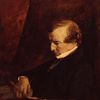
William Etty RA (10 March 1787 – 13 November 1849) was an English artist best known for his history paintings containing nude figures. He was the first significant British painter of nudes and still lifes. Born in York, he left school at the age of 12 to become an apprentice printer in Hull. He completed his apprenticeship seven years later and moved to London, where in 1807 he joined the Royal Academy Schools. There he studied under Thomas Lawrence and trained by copying works by other artists. Etty earned respect at the Royal Academy of Arts for his ability to paint realistic flesh tones, but had little commercial or critical success in his first few years in London.
Etty's Cleopatra's Arrival in Cilicia, painted in 1821, featured numerous nudes and was exhibited to great acclaim. Its success prompted several further depictions of historical scenes with nudes. All but one of the works he exhibited at the Royal Academy in the 1820s contained at least one nude figure, and he acquired a reputation for indecency. Despite this, he was commercially successful and critically acclaimed, and in 1828 was elected a Royal Academician, at the time the highest honour available to an artist. Although he was one of the most respected artists in the country he continued to study at life classes throughout his life, a practice considered inappropriate by his fellow artists. In the 1830s Etty began to branch out into the more lucrative but less respected field of portraiture, and later became the first English painter to paint significant still lifes. He continued to paint both male and female nudes, which caused severe criticism and condemnation from some elements of the press.
An extremely shy man, Etty rarely socialised and never married. From 1824 until his death he lived with his niece Betsy (Elizabeth Etty). Even in London he retained a keen interest in his native York, and was instrumental in the establishment of the town's first art school and the campaign to preserve York city walls. While he never formally converted from his Methodist faith, he was deeply attached to the Roman Catholic Church and was one of the few non-Catholics to attend the 1838 opening of Augustus Pugin's chapel for St Mary's College, Oscott, at that time England's most important Roman Catholic building.
Etty was prolific and commercially successful throughout the 1840s, but the quality of his work deteriorated throughout this period. As his health progressively worsened he retired to York in 1848. He died in 1849, shortly after a major retrospective exhibition. In the immediate aftermath of his death his works became highly collectable and sold for large sums. Changing tastes meant his work later fell out of fashion, and imitators soon abandoned his style. By the end of the 19th century the value of all of his works had fallen below their original prices, and outside his native York he remained little known throughout the 20th century. Etty's inclusion in Tate Britain's landmark Exposed: The Victorian Nude exhibition in 2001–02, the high-profile restoration of his The Sirens and Ulysses in 2010 and a major retrospective of his work at the York Art Gallery in 2011–12 led to renewed interest in his work.