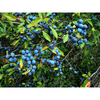

A shrub with a height of 3.5-4.5 m, less often a stunted tree no higher than 8 m. Growing and expanding with the help of root offspring, the thorn forms dense prickly and impenetrable thickets. The branches are abundantly covered with thorns.
The leaves are elliptical or obovate, toothed, up to 5 cm long.
The flowers are small, white, open singly or in pairs in early spring, when there are no leaves yet. Flowering is very abundant, in April-May, before leaf-spreading.
The fruits are rounded single-walled, similar to a plum, with a bluish waxy coating, 12 mm in diameter, tart-sour to taste, ripen late.
Distribution
The range covers almost the whole of Europe. The northern border runs north of 60 ° S. along the Scandinavian Peninsula and the extreme southwest of Finland, in the east it reaches Mordovia and the southern part of Tatarstan. It is also found in Kazakhstan, Tunisia, Asia Minor and Iran.
It usually grows in dense thickets, mainly in the forest-steppe and in the spikes of shrubs in the steppe, often along the edges of the forest, in cutting areas. In the Crimea and the Caucasus, it occurs up to heights of 1200-1600 meters above sea level.
Economic significance and application
Thorn bones. Belgorod region
Honeybee, gives bees mainly pollen-pollen and a little nectar. Honey productivity per hectare in fresh oak forests is 32-88 kg, on dry heavily eroded soils 34-57 kg/ha. Thorn, growing on fresh soils, reacts strongly to meteorological conditions. On dry soils, meteorological conditions have a lesser impact on productivity, which characterizes it as a drought-resistant breed.
In folk medicine, blackthorn fruits were used for gastrointestinal diseases, as well as as a blood purifying, dietary and anti-inflammatory agent. It was believed that the decoction of flowers has diuretic, diaphoretic, laxative, antitoxic and blood-purifying properties. Decoctions were prepared from the leaves of plants, which were used for kidney diseases. Fruits and roots were used to produce paint. The fruits are consumed raw, jam and compote are cooked from them.
The thorn has many tetraploid hybrids with other species. Their correct name is hybrid thorn. For the Middle part of Russia, the Apricot blackthorn (a hybrid of blackthorn with black apricot) and the forms of fragrant blackthorn (hybrids with Chinese-American plum) are suitable.') '10-17', '16-9', '83'. Their fruits are almost without astringency, fragrant. Winter hardiness at the level of the thorn.
The thorn wood is very strong and hard, brown-reddish in color, it lends itself well to polishing. It is used in the production of small carpentry and turning products, canes.
Blackthorn is also used as decorative hedges. Thorn bushes are specially planted on slopes, in ravines, along the banks of rivers and canals to strengthen them. It serves as an excellent rootstock for shrub forms of peach, apricot and plum.
In England, by insisting gin on sloe fruits with sugar, they get a popular dessert liqueur, which is called sloe gin.
Fruits contain about 8% sugars (levulose and sucrose), almost 2.5% acids (mainly malic), about 1% pectin and more than 1.5% tannins, vitamin C, red coloring matter. Because of the tart taste, the fruits are almost not eaten fresh; they are made into jam, compote, alcoholic beverage "ternovka", vinegar, kvass, added to soups for acidification. Toasted fruits together with leaves are a substitute for coffee. After freezing, the fruits become tastier and are suitable for fresh food. In France, pickled unripe blackthorn fruits are used instead of olives.
The seeds contain up to 37% of fatty oil, which may have a technical application. Seeds cannot be eaten because of the presence of the poisonous glycoside amygdalin in them.
The leaves contain about 200 mg% ascorbic acid. In some places they are used as a substitute for tea.
Bark and wood can be used for tanning leather[11].
Fruit juice and roots give green, yellow, red, brown and gray coloring.
It is sometimes eaten by cattle, horses, goats and sheep