
Person attributes


Other attributes


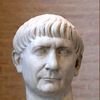
Trajan (/ˈtreɪdʒən/ TRAY-jən; Latin: Caesar Nerva Traianus; 18 September 53 – 9/11 August 117) was Roman emperor from 98 to 117. Officially declared by the Senate optimus princeps ("best ruler"), Trajan is remembered as a successful soldier-emperor who presided over the second-greatest military expansion in Roman history, after Augustus, leading the empire to attain its maximum territorial extent by the time of his death. He is also known for his philanthropic rule, overseeing extensive public building programs and implementing social welfare policies, which earned him his enduring reputation as the second of the Five Good Emperors who presided over an era of peace within the Empire and prosperity in the Mediterranean world.

Trajan wearing the civic crown and military garb such as a muscle cuirass, 2nd century AD, Antalya Archaeological Museum
Trajan was born in Italica, close to modern Seville in present-day Spain, an Italic settlement in the Roman province of Hispania Baetica. Although misleadingly designated by some later writers as a provincial, his Ulpia gens came from Umbria and he was born in the senatorial family. Trajan rose to prominence during the reign of emperor Domitian. Serving as a legatus legionis in Hispania Tarraconensis, in 89 Trajan supported Domitian against a revolt on the Rhine led by Antonius Saturninus. In September 96, Domitian was succeeded by the old and childless Nerva, who proved to be unpopular with the army. After a brief and tumultuous year in power, culminating in a revolt by members of the Praetorian Guard, he decided to adopt the more popular Trajan as his heir and successor. Nerva died in 98 and was succeeded by his adopted son without incident.

Trajan's Forum
As a civilian administrator, Trajan is best known for his extensive public building program, which reshaped the city of Rome and left numerous enduring landmarks such as Trajan's Forum, Trajan's Market and Trajan's Column.

Trajan's Market, 2013
Early in his reign, he annexed the Nabataean Kingdom, creating the province of Arabia Petraea. His conquest of Dacia enriched the empire greatly, as the new province possessed many valuable gold mines. Trajan's war against the Parthian Empire ended with the sack of the capital Ctesiphon and the annexation of Armenia, Mesopotamia and (possibly) Assyria. In late 117, while sailing back to Rome, Trajan fell ill and died of a stroke in the city of Selinus. He was deified by the Senate and his ashes were laid to rest under Trajan's Column. He was succeeded by his cousin Hadrian, whom Trajan supposedly adopted on his deathbed.

Trajan's Column
As an emperor, Trajan's reputation has endured – he is one of the few rulers whose reputation has survived nineteen centuries. Every new emperor after him was honoured by the Senate with the wish felicior Augusto, melior Traiano (that he be "luckier than Augustus and better than Trajan"). Among medieval Christian theologians, Trajan was considered a virtuous pagan. In the Renaissance, Machiavelli, speaking on the advantages of adoptive succession over heredity, mentioned the five successive good emperors "from Nerva to Marcus" – a trope out of which the 18th-century historian Edward Gibbon popularized the notion of the Five Good Emperors, of whom Trajan was the second.
An account of the Dacian Wars, the Commentarii de bellis Dacicis, written by Trajan himself or a ghostwriter and modelled after Caesar's Commentarii de Bello Gallico, is lost with the exception of one sentence. Only fragments remain of the Getica, a book by Trajan's personal physician Titus Statilius Criton. The Parthica, a 17-volume account of the Parthian Wars written by Arrian, has met a similar fate. Book 68 in Cassius Dio's Roman History, which survives mostly as Byzantine abridgements and epitomes, is the main source for the political history of Trajan's rule.

Bust of Trajan in 108 AD, in the Museum of Art History in Vienna, Austria