Other attributes
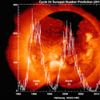
The solar cycle or solar magnetic activity cycle is a nearly periodic 11-year change in the Sun's activity measured in terms of variations in the number of observed sunspots on the solar surface. Sunspots have been observed since the early 17th century and the sunspot time series is the longest continuously observed (recorded) time series of any natural phenomena.
The magnetic field of the Sun flips during each solar cycle, with the flip occurring when sunspot cycle is near its maximum. Levels of solar radiation and ejection of solar material, the number and size of sunspots, solar flares, and coronal loops all exhibit a synchronized fluctuation, from active to quiet to active again, with a period of 11 years.
This cycle has been observed for centuries by changes in the Sun's appearance and by terrestrial phenomena such as auroras. Solar activity, driven both by the sunspot cycle and transient aperiodic processes govern the environment of the Solar System planets by creating space weather and impact space- and ground-based technologies as well as the Earth's atmosphere and also possibly climate fluctuations on scales of centuries and longer.
Understanding and predicting the sunspot cycle remains one of the grand challenges in astrophysics with major ramifications for space science and the understanding of magnetohydrodynamic phenomena elsewhere in the Universe.