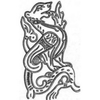

Simargl, son of Svarog, is the god of fire, heat, blacksmithing, hearth, god of the moon, guardian of the fiery lunar path to Irius. He is the guardian of the sacred living Fire of rebirth. Patron of all fiery rites and fiery purifications. Guardian of spiritual origins, protector, and tireless hunter of dark spirits and demons. He is the god who does not allow darkness to envelop everything.
emargl, or Simargl - god of the fire element of the Russian Vedic pantheon, young Svarozhich, born in the Forge of Heaven, patron of the primordial fire, the fire of the hearth, giving heat and light, and the living fire, kindled to the glory of the Gods at services and ceremonies, mediator between heaven and earth and messenger of the gods, for which there are no obstacles. He is the Light that drives away darkness, burning out with a fierce flame and purifying white light from it.
He is a Healer-god, driving away disease - when the temperature rises, it is believed that Fire God Semargul with a blazing heat drives away disease and cleanses the body from the dark plague. He patronizes all who have a pure Soul, an open Heart, follow the Way of the Righteousness in their lives and obey the commandments of the Gods. Semargle - light and wise god of fiery elements, protecting against misfortune. He scorches with fiery fire the dark forces, the world is obscured by curse, from the way of the Right. Semargle - all-knowing, prophetic god, versed in all the mysteries of the universe.
He accepts gifts and rewards from the people and brings them to the gods in Swarga the Light. The Fire God Semargle is the source of life-giving power, for without heat and light there is no life on earth. The sacred bird of Ognebog is the falcon Rarog - a whirlwind of fire, the fiery bird, shining with its light-bearing heat in the sky. Semarglu is glorified on all four main holy days of the year, all rituals of which are connected with the purifying power of fire. Without him not a single sacred action takes place, he is called upon on all traditional folk festivals.
Semargle: symbols and his prototypes. Versions of origin
Many different versions about who the Slavic god Semargle is, express the researchers of the past. According to one version, a clear resemblance is traced to a deity from Iranian mythology, referred to as Simurgh, or the Bird of Saen (mərəγō saēnō), or Sēnmurw (Sēnmurw). During the Iranian dynasty of the Parthian Arshakid kings (3rd century BC - 3rd century AD) and the Persian Sassanid dynasty (3rd - 7th centuries AD) it was depicted on the emblem of Iran. Fire was a holy thing for the Persians, and it is not by chance that the image of the fiery Semargul painted on the emblem of Iran in those distant times. Avestan deity of justice and happiness Simurg - the eternal king-bird, the mirror of light, patronizing people, all elements of nature are under her control, she experienced more than once ruin and rebirth of the world, she knows the secrets of past, present and future. Zoroastrianism describes the image of Simurgh, who sits under the original world tree in the middle of the ocean Vaurukasha, and the beating of his wing causes life-giving seeds to fly around the world. His name is mentioned in the Sufi poem "The Conversation of Birds" (Mantik-al-Tayr) by Attar.

We can discover the great wisdom hidden in the narrative of this tale - the story is told of how the birds, representing the feelings that i
We can discover the great wisdom hidden in the narrative of this tale - the story is told of how the birds, representing the feelings that impede the path of the seeker of the Truth, choose Simurgh as their king and seek him throughout the world, overcoming various difficulties and obstacles. They learn from their mentor that the palace of Simurgh (sainamarga - 'bird from the top' or 'supreme bird') is situated on the top of Mount Kaf beyond the seven seas, which belongs to a mountain ring-like ridge surrounding a mysterious land. Not everyone reaches the goal of the journey, some die on the flight, some do not survive the ordeal of the Way and go back.
After traversing seven valleys and seven seas, only thirty birds (Persian: si-morgh '30 birds') remain, and they find his abode in a vast lake, in which they discover not the face of Simurgh they sought, but their reflections... Thus the whole essence of comprehension is revealed to them. Having overcome so many trials on the Path, they finally realized that the Simurgh is each and every one of them and all of them together: "Thirty birds in a single name fly, keeping both secret and light within themselves." This poem-parable is about the fact that God is the totality of all things, not something that exists apart from us all, distant and unattainable. He is everywhere and in all of us.
There is a legend of the Simurgh that says he lives for several hundred years, and when his son grows up, he throws himself into the fire, taking him into eternity. He is a prophetic bird of happiness, the god of justice and guardian of the inter-world.


