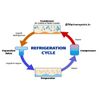
Overview of Components
Four fundamental elements of a basic cycle are as follows:
The compressor
The condenser
The expansion device
The evaporator
THERMOSTATIC EXPANSION VALVE (TXV)
Before the evaporator, this is located at the end of the liquid line. TXV is a device that controls the amount of refrigerant that flows to the evaporator. There you will find the floodback that is essential to maximise the productivity of the evaporator, while stopping the extra liquid refrigerant from going back to the compressor.
This device also helps to separate the high pressure and the low pressure sides of an air conditioning system. Through the system’s liquid line, high pressured liquid refrigerant enters the valve but with the TVX’s presence, the amount of liquid refrigerant entering the evaporator will be abridged.

EVAPORATOR
The sole purpose of the evaporator is to remove the unwanted heat from the product through liquid refrigerants. The liquid refrigerant must be at a low-pressure. This low-pressure can be determined by two factors – one is the heat being absorbed from the product to the liquid refrigerant and the other is the removal of low-pressure vapour by the compressor.
CAPACITY CONTROL SYSTEM
As its name might suggest, the capacity control system regulates the power and energy consumption, although it can also manage dehumidification or decrease compressor cycling. The on/off cycling of the compressor is the simplest form of capacity control.

COMPRESSOR
This draws low-temperature and low-pressure vapour from the evaporator through the suction line; the vapour will automatically be compressed once diverted – there will also be a rise in the temperature if the vapour is compressed. In simple terms, a compressor can convert low-temperatures to high-temperatures, which can be the cause of an increase in pressure. Through a compressor, heat can be easily released.
CONDENSER
This device can extract heat from the refrigerant. Fans placed above the condenser unit draw air over the condenser coils. The temperature of condensation should range from around -12°C to -1°C; vapour will be cooled until it becomes a liquid refrigerant again, whereby it will retain some heat.

RECEIVER
As a temporary storage and a surge tank for liquid refrigerant, the receiver acts as a vapour seal. With a primary purpose of preserving the vapour moving down the liquid line to the expansion valve, receivers can be made for both horizontal and vertical installation.


