A prokaryote (/proʊˈkærioʊt, -ət/) is a single-celled organism that lacks a nucleus, and other membrane-bound organelles. The word prokaryote comes from the Greek πρό (pro, 'before') and κάρυον (karyon, 'nut' or 'kernel'). In the two-empire system arising from the work of Édouard Chatton, prokaryotes were classified within the empire Prokaryota. But in the three-domain system, based upon molecular analysis, prokaryotes are divided into two domains: Bacteria (formerly Eubacteria) and Archaea (formerly Archaebacteria). Organisms with nuclei are placed in a third domain, Eukaryota. In the study of the origins of life, prokaryotes are thought to have arisen before eukaryotes.

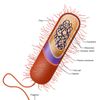
Diagram of a typical prokaryotic cell
Besides the absence of a nucleus, prokaryotes also lack mitochondria, or any other membrane-bound organelles that characterize the eukaryotic cell, and it was once thought that prokaryotic cellular components within the cytoplasm were unenclosed, except for an outer cell membrane. But bacterial microcompartments, which are thought to be simple organelles enclosed in protein shells, have been discovered, along with other prokaryotic organelles.[8] While typically being unicellular, some prokaryotes, such as cyanobacteria, may form large colonies. Others, such as myxobacteria, have multicellular stages in their life cycles. Prokaryotes are asexual, reproducing without fusion of gametes, although horizontal gene transfer also takes place.
Molecular studies have provided insight into the evolution and interrelationships of the three domains of life. The division between prokaryotes and eukaryotes reflects the existence of two very different levels of cellular organization; only eukaryotic cells have an enveloped nucleus that contains its chromosomal DNA, and other characteristic membrane-bound organelles including mitochondria. Distinctive types of prokaryotes include extremophiles and methanogens; these are common in some extreme environments