
Technology attributes

Proton Exchange Membrane Fuel Cells (PEMFC) are a sustainable means of power generation through electrochemical conversion of hydrogen-containing fuels especially in portable, stationary, and automotive applications.
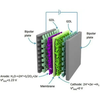
Polymer electrolyte membrane (PEM) fuel cells are the current focus of research for fuel cell vehicle applications. PEM fuel cells are made from several layers of different materials. The main parts of a PEM fuel cell are described below.
The heart of a PEM fuel cell is the membrane electrode assembly (MEA), which includes the membrane, the catalyst layers, and gas diffusion layers (GDLs).
The membrane, catalyst layers (anode and cathode), and diffusion media together form the membrane electrode assembly (MEA) of a PEM fuel cell.

The polymer electrolyte membrane, or PEM (also called a proton exchange membrane)—a specially treated material that looks something like ordinary kitchen plastic wrap—conducts only positively charged ions and blocks the electrons. The PEM is the key to the fuel cell technology; it must permit only the necessary ions to pass between the anode and cathode. Other substances passing through the electrolyte would disrupt the chemical reaction. For transportation applications, the membrane is very thin—in some cases under 20 microns.

A layer of catalyst is added on both sides of the membrane—the anode layer on one side and the cathode layer on the other. Conventional catalyst layers include nanometer-sized particles of platinum dispersed on a high-surface-area carbon support. This supported platinum catalyst is mixed with an ion-conducting polymer (ionomer) and sandwiched between the membrane and the GDLs. On the anode side, the platinum catalyst enables hydrogen molecules to be split into protons and electrons. On the cathode side, the platinum catalyst enables oxygen reduction by reacting with the protons generated by the anode, producing water. The ionomer mixed into the catalyst layers allows the protons to travel through these layers.

The GDLs sit outside the catalyst layers and facilitate transport of reactants into the catalyst layer, as well as removal of product water. Each GDL is typically composed of a sheet of carbon paper in which the carbon fibers are partially coated with polytetrafluoroethylene (PTFE). Gases diffuse rapidly through the pores in the GDL. These pores are kept open by the hydrophobic PTFE, which prevents excessive water buildup. In many cases, the inner surface of the GDL is coated with a thin layer of high-surface-area carbon mixed with PTFE, called the microporous layer. The microporous layer can help adjust the balance between water retention (needed to maintain membrane conductivity) and water release (needed to keep the pores open so hydrogen and oxygen can diffuse into the electrodes).

Each individual MEA produces less than 1 V under typical operating conditions, but most applications require higher voltages. Therefore, multiple MEAs are usually connected in series by stacking them on top of each other to provide a usable output voltage. Each cell in the stack is sandwiched between two bipolar plates to separate it from neighboring cells. These plates, which may be made of metal, carbon, or composites, provide electrical conduction between cells, as well as providing physical strength to the stack. The surfaces of the plates typically contain a “flow field,” which is a set of channels machined or stamped into the plate to allow gases to flow over the MEA. Additional channels inside each plate may be used to circulate a liquid coolant.

Metal bipolar plate

graphite bipolar plate
Each MEA in a fuel cell stack is sandwiched between two bipolar plates, but gaskets must be added around the edges of the MEA to make a gas-tight seal. These gaskets are usually made of a rubbery polymer.


