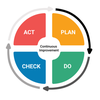

The Plan-Do-Check-Act cycle
is a four-step model for carrying out change. Just as a circle has no end, the PDCA cycle should be repeated again and again for continuous improvement. The PDCA cycle is considered a project planning tool. It is an essential part of the lean manufacturing philosophy and a key prerequisite for continuous improvement of people and processes.
History
The Plan-Do-Check-Act (PDCA) Cycle is a four-step problem-solving iterative technique used to improve business processes. Originally developed by American physicist Walter A. Shewhart during the 1920s, the cycle draws its inspiration from the continuous evaluation of management practices and management’s willingness to adopt and disregard unsupported ideas.
The method was popularized by quality control pioneer Dr. W. Edwards Deming in the 1950s who coined the term “Shewhart” Cycle after his mentor. It was Deming who realized the PDCA Cycle could be used to improve production processes in the United States during World War II.
WHEN TO USE THE PDCA CYCLE
- Starting a new improvement project
- Developing a new or improved design of a process, product, or service
- Defining a repetitive work process
- Planning data collection and analysis in order to verify and prioritize problems or root causes
- Implementing any change
- Working toward continuous improvement
The Plan-do-check-act Procedure
- Plan: Recognize an opportunity and plan a change.
- Do: Test the change. Carry out a small-scale study.
- Check: Review the test, analyze the results, and identify what you’ve learned.
- Act: Take action based on what you learned in the study step. If the change did not work, go through the cycle again with a different plan. If you were successful, incorporate what you learned from the test into wider changes. Use what you learned to plan new improvements, beginning the cycle again.