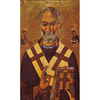

Nicholas the Wonderworker[2]; Nicholas the Ugodnik; Nicholas of Myra[1]; Saint Nicholas (Greek Άγιος Νικόλαος - Saint Nicholas; about 270, Patara[1], Lycia - about 345, Myra[1], Lycia) is a saint in historic churches, archbishop of Myra of Lycia[3] (Byzantium). In Christianity he is revered as a miracle worker, in the East he is the patron of travelers, prisoners and orphans,[4] in the West - the patron of almost all walks of life, but mostly children[5].
He is depicted both with and without a mitre on his head, a symbol of his bishopric. St. Nicholas gave rise to the character of Santa Claus[6]. Christmas presents originated from his hagiography, which tells of St. Nicholas giving a dowry to the three daughters of a ruined rich man.
In ancient hagiographies, St. Nicholas of Myra was usually confused with St. Nicholas of Pinar (of Zion) because of the similar details of the saints' life stories: both were from Lycia, archbishops, revered saints and miracle workers. These coincidences led to the misconception, which existed for many centuries, that there was only one Saint Nicholas the Wond
Life Description
According to his hagiography, Saint Nicholas was born in the third century in the Greek colony of Patara in the Asia Minor Roman province of Lycia at a time when the region was Hellenistic in culture. Nicholas was very religious from an early age and devoted his life entirely to Christianity. He is believed to have been born into a family of wealthy Christian parents and to have received an elementary education. Because his biography is confused with that of Nicholas of Pinar, there has been an erroneous opinion for several centuries that the parents of Nicholas of Myra were Theophanes (Epiphanius) and Nonna.
From his childhood, Nicholas excelled in the study of the Holy Scriptures; during the day he did not leave the temple, and at night he prayed and read books, building within himself a dignified dwelling of the Holy Spirit. His uncle, the bishop of Patarsk, ordained him an reader, and then ordained him a priest, making him his assistant and entrusting him with the task of preaching to the flock. In the fourth century, such an appointment was possible only after the council of the Lycian bishops had ordained him as a reader and then elevated him to the rank of priest, making him his assistant, and entrusting him with the task of delivering sermons to the flock. Such an appointment was possible in the fourth century[1].
When his parents died, St. Nicholas gave his inherited fortune to the needy.
Fresco of the Cathedral of the Ferapontov Monastery (Dionysius, 1502)
The beginning of the priestly ministry of Saint Nicholas dates back to the reign of the Roman emperors Diocletian (ruled 284-305) and Maximian (ruled 286-305). In the year 303 Diocletian issued an edict, which legalized the systematic persecution of Christians throughout the empire. After the abdication of both emperors on May 1, 305, there were changes in the policies of their successors toward Christians. In the western part of the empire Constantius Chlorus (reigned 305-306) ended the persecution after his accession to the throne. In the eastern part, Galerius (ruled 305-311) continued the persecution until 311, when he issued an edict of religious tolerance while already on his deathbed. The persecutions of 303-311 are considered the longest in the history of the empire.
After Galerius' death, his co-ruler Licinius (reigned 307-324) largely tolerated Christians. Christian communities began to develop. The bishopric of St. Nicholas in Mira (modern Demre, Antalya Province, Turkey) belongs to this period. He fought against paganism, in particular the destruction of the temple of Artemis Eleuthera in Mire is attributed to him[1].
He zealously defended the Christian faith against heresies, especially Arianism. The Greek Damascene Studite, Metropolitan of Navpakt and Art (16th century), in his book "Θησαυρός" ("The Treasure") sets forth a legend according to which during the Nicene (First Ecumenical) Council (325) St. Nicholas slapped his opponent Arius[10]. However, Peter de Nathalibus writes that St. Nicholas did not slap Arius himself, but one of his followers[11][12]. This story first appeared a thousand years after the Council of Nicaea (in the fourteenth century)[13]. There is serious doubt as to whether Nicholas was a participant in the Council, since no bishop (of those present at the Council) mentions him[14]. The professor of church history Vasily Bolotov in "Lectures on history of the Ancient Church" writes: "None of the stories about the Council of Nicaea, even with a weak claim to antiquity, does not mention among its participants the name of Nicholas, bishop of Myra". Herewith professor archpriest Vladislav Tsypin considers that since the most reliable documents mention the names only of some fathers of Nicaea, we should not take this argument seriously and not trust the church legend[15]. In the opinion of the professor archpriest Livery Voronov, the statement about the slap to Arius "cannot be recognized as true first of all because it stands in sharp contradiction with the perfect moral image of the great Hierarch", on the one hand, and with the Rules of the Holy Apostles, on the other. Nevertheless, according to his own words, the Church "does not doubt the validity of the fact of the council's judgment of St. Nicholas" for this transgression. Livery Voronov confirms on the basis of the analysis of the vocabulary of church canticles that St. Nicholas called Arius "insane blasphemer"[16].
There is no fact of zaushchenija Arias and court over Nikolay in the hagiography of the saint, written Simeon Metaphrast in X century but in it is marked, that Saint Nikolay was on Nicaea cathedral and "resolutely has risen against heresy Arias" [17]. In Russian hagiography the description of the slap appeared only at the end of the 17th century in the Lives of the Saints, written by Metropolitan Demetrius of Rostov, is also given in the text of the Minei for December 6[18].
Saint Nicholas is known as a defender of the slandered, often sparing the innocently condemned, and a prayer for sailors and other trav
elers.
Acts and Miracles
The salvation of the sailors.
Gentile da Fabriano, c. 1425
St. Nicholas is the patron saint of sailors, often called upon by sailors in danger of sinking or shipwreck. According to the hagiography, as a young man Nicholas went to Alexandria to study, and on one of his sea voyages from Myra to Alexandria he resurrected a sailor who had fallen off the ship's rigging in a storm and crashed to his death[19]. On another occasion, Nicholas saved a sailor on his way back to Mira from Alexandria and took him with him to church upon his arrival.
A dowry for three maidens.
Gentile da Fabriano, c. 1425
The hagiography of St. Nicholas describes the story of how St. Nicholas helped three girls whose father, unable to collect a dowry, planned to profit from their beauty. Upon learning of this, St. Nicholas decided to help them. Being modest (or wishing to spare them the humiliation of accepting help from an outsider), he threw a bag of gold into their home and returned home himself. The delighted father of the maidens gave one of his daughters in marriage and used the money for her dowry. Some time later, St. Nicholas tossed a bag of gold also for his second daughter, which allowed the second maiden to marry, secured by a dowry. After that, the father of the daughters decided to find out who his benefactor was, and so he kept watch all night to wait for him. His expectation was justified: St. Nicholas once more threw the sack of gold through the window and hurried away. Hearing the ringing of the gold, the maidens' father ran after the benefactor and, recognizing Saint Nicholas, threw himself at his feet, saying that he had saved them from perdition. St. Nicholas, not wanting his good deed to become known, took an oath from him that he would not tell anyone about it.[20][21][22]
According to Catholic legend, the sack thrown through the window by St. Nicholas landed in a stocking left to dry in front of the fire. From this came the custom of hanging out socks for presents from Santa Claus[21].
Even during his lifetime St. Nicholas became famous as a pacifier of the feuding, protector of the innocently condemned, and deliverer from sudden death. In the work called "Acts of the Stratilates," he describes the salvation of three citizens of the city of Myra, unjustly condemned to execution, and then of three Constantinople military leaders or stratilates (military leaders)[1]. The Venerable Simeon Metaphrastus and, on his basis, St. Demetrius of Rostov describe this act as follows. At a time when Saint Nicholas was already bishop of Myra, in the reign of Emperor Constantine I a revolt broke out in Phrygia. In order to subdue the rebellion, the king sent there an army under three commanders: Nepotianos, Ursos, and Erpilio. Sailing from Constantinople, they stopped at the harbor of Andriake (the Adriatic coast) near Mir. During their anchorage, some of the soldiers, going ashore to buy necessities, took away much by violence. The locals became embittered, and strife and enmity broke out between them and the soldiers, leading to a clash at the so-called Placoma. Upon learning of this, Saint Nicholas decided to put an end to the disturbance. When he arrived there, he began to persuade the commanders to keep their soldiers in obedience and not allow them to oppress the people. Then the commanders punished the guilty soldiers and calmed the commotion. At that time several citizens of Myra in Lycia came to Saint Nicholas, asking him to protect the slandered three men from their city, who, in the absence of Bishop Nicholas, had been condemned to death by the governor Eustathius. Then the saint, accompanied by the magistrates, set out to rescue the condemned. On reaching the place of execution, he saw, that the condemned men already kneeled to the ground and were waiting to strike the executioner's sword. Then St. Nicholas snatched the sword from the executioner's hands and freed the condemned. Thereupon the military commanders set out for Phrygia to carry out the royal command given to them. Having put down the insurrection, they returned home. The king and his nobles praised and honored them. Some of the nobles, however, being jealous of their fame, slandered them before the prefect of the Praetorium of the East, Ablabius, gave him money and told him that the magistrates were plotting against the king. After the prefect Ablabius reported this to the king, the latter ordered the magistrates to be imprisoned without investigation. The accusers were afraid that their slander would become known, so they begged the governor to condemn the magistrates to death. The governor agreed and went to the king and persuaded the emperor to execute the magistrates. Since it was evening, the execution was postponed until the morning. The keeper of the dungeon, finding this out, informed the governors. Then the voivode Nepotian remembered Saint Nicholas, and they began to pray to the saint to deliver them. That same night Saint Nicholas appeared in a dream to the king and told him that he was to free the slandered military leaders and threatened him with death, unless he did what he asked.


