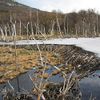
Niche construction is the process by which an organism alters its own (or another species') local environment. These alterations can be a physical change to the organism’s environment or encompass when an organism actively moves from one habitat to another to experience a different environment. Examples of niche construction include the building of nests and burrows by animals, and the creation of shade, influencing of wind speed, and alternation of nutrient cycling by plants. Although these alterations are often beneficial to the constructor, they are not always (for example, when organisms dump detritus, they can degrade their own environments).

Beavers hold a very specific biological niche in the ecosystem: constructing dams across river systems.
1) The organism must significantly modify environmental conditions.
2) These modifications must influence one or more selection pressures on a recipient organism.
3) There must be an evolutionary response in at least one recipient population caused by the environmental modification.
The first two criteria alone provide evidence of niche construction.
Recently, some biologists have argued that niche construction is an evolutionary process that works in conjunction with natural selection.Evolution entails networks of feedbacks in which previously selected organisms drive environmental changes, and organism-modified environments subsequently select for changes in organisms.The complementary match between an organism and its environment results from the two processes of natural selection and niche construction. The effect of niche construction is especially pronounced in situations where environmental alterations persist for several generations, introducing the evolutionary role of ecological inheritance.This theory emphasizes that organisms inherit two legacies from their ancestors: genes and a modified environment. A niche constructing organism may or may not be considered an ecosystem engineer.Ecosystem engineering is a related but non-evolutionary concept referring to structural changes brought about in the environment by organisms.
Earthworms physically and chemically modify the soil in which they live. Only by changing the soil can these primarily aquatic organisms live on land.Earthworm soil processing benefits plant species and other biota present in the soil, as originally pointed out by Darwin in his book The Formation of Vegetable Mould through the Action of Worms.
Lemon ants (Myrmelachista schumanni) employ a specialized method of suppression that regulates the growth of certain trees. They live in the trunks of Duroia hirsuta trees found in the Amazonian rain forest of Peru. Lemon ants use formic acid (a chemical fairly common among species of ants) as a herbicide. By eliminating trees unsuitable for lemon ant colonies, these ants produce distinctive habitats known as Devil's gardens.
Beavers build dams and thereby create lakes that drastically shape and alter riparian ecosystems. These activities modify nutrient cycling and decomposition dynamics, influence the water and materials transported downstream, and ultimately influence plant and community composition and diversity.
Benthic diatoms living in estuarine sediments in the Bay of Fundy, Canada, secrete carbohydrate exudates that bind the sand and stabilize the environment. This changes the physical state of the sand which allows other organisms (such as the amphipod Corophium volutator) to colonize the area.
Chaparrals and pines increase the frequency of forest fire through the dispersal of needles, cones, seeds and oils, essentially littering the forest floor. The benefit of this activity is facilitated by an adaptation for fire resistance which benefits them relative to their competitors.
Saccharomyces cerevisiae yeast creates a novel environment out of fermenting fruit. This fermentation process in turn attracts fruit flies that it is closely associated with and utilizes for transportation.
Cyanobacteria provide an example on a planetary scale through the production of oxygen as a waste product of photosynthesis (see Great Oxygenation Event). This dramatically changed the composition of the Earth’s atmosphere and oceans, with vast macroevolutionary and ecological consequences.
Microbialites represent ancient niches constructed by bacterial communities which give evidence that niche construction was present on early life forms.

Leafcutter ants fill a vital niche in the rainforest ecosystem
An important consequence of niche construction is that it can affect the natural selection experienced by the species doing the constructing. The common cuckoo illustrates such a consequence. It parasitizes other birds by laying its eggs in their nests. This had led to several adaptations among the cuckoos, including a short incubation time for their eggs. The eggs need to hatch first so that the chick can push the host's eggs out of the nest, ensuring it has no competition for the parents' attention. Another adaptation it has acquired is that the chick mimics the calls of multiple young chicks, so that the parents are bringing in food not just for one offspring, but a whole brood.
Niche construction can also generate co-evolutionary interactions, as illustrated by the above earthworm, beaver and yeast examples.
The development of many organisms, and the recurrence of traits across generations, has been found to depend critically on the construction of developmental environments such as nests by ancestral organisms. Ecological inheritance refers to the inherited resources and conditions, and associated modified selection pressures, that ancestral organisms bequeath to their descendants as a direct result of their niche construction.
Niche construction has important implications for understanding, managing, and conserving ecosystems.
Niche construction theory (NCT) has been anticipated by diverse people in the past, including by the physicist Erwin Schrödinger in his What Is Life? and Mind and Matter essays (1944). An early advocate of the niche construction perspective in biology was the developmental biologist, Conrad Waddington. He drew his attention to the many ways in which animals modify their selective environments throughout their lives, by choosing and changing their environmental conditions, a phenomenon that he termed "the exploitive system".
The niche construction perspective was subsequently brought to prominence through the writings of Harvard evolutionary biologist, Richard Lewontin. In the 1970s and 1980s Lewontin wrote a series of articles on adaptation, in which he pointed out that organisms do not passively adapt through selection to pre-existing conditions, but actively construct important components of their niches.
Oxford biologist John Odling-Smee (1988) was the first person to coin the term 'niche construction', and the first to make the argument that ‘niche construction’ and ‘ecological inheritance’ should be recognized as evolutionary processes.Over the next decade research into niche construction increased rapidly, with a rush of experimental and theoretical studies across a broad range of fields.
Mathematical evolutionary theory explores both the evolution of niche construction, and its evolutionary and ecological consequences. These analyses suggest that niche construction is of considerable importance. For instance, niche construction can:
fix genes or phenotypes that would otherwise be deleterious, create or eliminate equilibria, and affect evolutionary rates;
cause evolutionary time lags, generate momentum, inertia, autocatalytic effects, catastrophic responses to selection, and cyclical dynamics;
drive niche-constructing traits to fixation by creating statistical associations with recipient traits;
facilitate the evolution of cooperation;
regulate environmental states, allowing persistence in otherwise inhospitable conditions, facilitating range expansion and affecting carrying capacities;
drive coevolutionary events, exacerbate and ameliorate competition, affect the likelihood of coexistence and produce macroevolutionary trends.