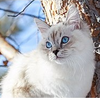


The Neva masquerade cat is a long—haired breed with a point color that gives it a resemblance to a Siamese or Thai cat, and bright blue eyes. It is a subspecies of the Siberian cat. It is mainly bred in Russian nurseries. It got its name because of the color of the muzzle, resembling a mask.
History of the breed
The history of the Neva masquerade cat breed begins in the XX century. This is a fairly young breed, gaining more and more popularity. Neva Masquerade dogs have been bred since 1989 . The breed was officially recognized by international organizations in 1992 . But not all organizations recognize it as an independent breed.
The origin of the Neva masquerade cats goes back to the Siberian cats that lived for many centuries in Siberia. This is the so-called aboriginal breed, formed independently under the influence of the environment. "Siberians" are the progenitors of many modern breeds of semi-long-haired cats. In Russia, such cats have been known since the XVIII century, since the time of Peter the Great.
The exact place of origin of the breed is unknown. Masquerade cats were first bred in St. Petersburg, at the Kotofey club under the guidance of breeder Olga Mironova.
Actually, this gave the name of the breed — Nevsky — in honor of the river on which the city stands. The second name — masquerade — cat owes a peculiar color: dark fur on the muzzle looks like a mask.
Further breeding work continued in Moscow. St. Petersburg and Moscow nurseries preferred to work independently of each other. This gave a wide field for activity and led to a greater variety of so-called nevaks.

Description of the breed
Neva masquerade cat is a cat with long fur and blue eyes, which can have different shades of blue: from light to sapphire.
The wool of the masquerade cat, like the Siberian wool, is hypoallergenic. Allergy to the Neva cat is less common than to other breeds, although exceptions are found. To make sure that the Neva masquerade will not cause allergies, you need to do a wool analysis. The opinion that only females are allergenic is erroneous.
The WCF standard provides the following characteristics.
General characteristics: strong, massive, muscular cats of medium or large size. Cats are significantly smaller than cats.
Strong backbone with well-developed musculature; dense, massive, of medium length. Limbs of medium height, strong, forming a rectangle with the body. Strong, short, powerful neck, broad chest; the body is proportional to the creation of a rectangular outline. The paws are large, round, with tufts of fur between the toes.
The head is in the form of a short wide trapezoid in good proportion to the body, massive. The forehead is broad, slightly rounded. Smooth transition from a low forehead to a wide straight back of the nose. The nose is of medium length, wide, a slight depression is visible in profile, but without a foot. Cheekbones are low, cheeks are full, jaws are well developed. The chin is wide, strong enough, but not protruding. Ears of medium size, wide at the base, spaced at a distance of more than the width of one ear at the base. The outer line of the ear is vertical, the outer edge of the base of the ear is located just above eye level. The ears are slightly tilted forward. The tips are rounded. Brushes and brushes are desirable.
The eyes are large, rounded, wide and slightly obliquely set. The eye color is blue, saturated, evenly colored.
The tail is broad and strong at the base, almost as long as the shoulder blades, well pubescent. The tip is rounded.
The coat is semi-long; the covering hair is hard, shiny, water-repellent, lengthening from the shoulder blades to the croup, falling on the sides and the upper part of the tail. On the sides, the wool is softer, loosely fitting, very dense. The undercoat is double, depending on the season: slight short tight-fitting in the warm season, in winter — abundant long, very thick and dense, with a fine texture. The adorning coat is long, but dense, in the form of a mane, a full collar and a frill. Lush "pants" and a perfectly pubescent tail. Short hair on the shoulder blades. With seasonal molting, almost nothing remains of the adorning wool.

Coloring of Neva masquerade cats
There are only six color options for this breed. The most common are "seal point" (Seal—point), which got its name from the English word "seal", and "seal tabby point" (seal tabby point). Another type of color of the Neva masquerade cat is "Red point" (Red-point). This tone implies the transitions of the coat color into the red spectrum. There are also the following colors of this breed:
- — "Blue point" (Blue-point) — bluish colors in wool;
- — "turtle point" (Turtle-point), as a rule, occurs only in cats.
Instances with silvery shades on all other ponts have become more common. White "socks" on the paws and the same color and tone spots on the muzzle can be in all six colors. Nevsky masquerade bicolor does not require symmetry and ordering of the shapes of specks. The chocolate-purple color does not meet the exhibition standards.
Personality
Reviews about the nature of the Neva masquerade cats are mostly positive. They are quite independent and do not require much attention to themselves. Representatives of the breed are distinguished by balance, a strong nervous system and a healthy psyche. Manners of behavior can be called aristocratic: animals are graceful, neat, affectionate. They are friendly, sociable, but at the same time unobtrusive. Moderately playful and active. They do not tolerate loneliness well. They differ in freedom, sometimes stubbornness.
Representatives of the breed are strongly attached to their owners, are considered loyal, patient, forgetful animals, endowed with extraordinary intelligence. Nevsky Masquerade prefers partnerships, is a good companion. These cats are recommended for families with children, they protect babies, show attention and care, and willingly play with older children. Non-aggressive: an adult cat will prefer to leave rather than use teeth and claws. Strangers are treated with caution. One of the advantages of the breed is friendliness towards other pets.
Health
Like many native breeds, they have strong immunity, are not susceptible to diseases. Rarely susceptible to hereditary diseases. The main disease dangerous for them is hypertrophic cardiomyopathy.
Neva masquerade cats are long—lived among their relatives - there are representatives among them who live in the world for more than 10-20 years.