Other attributes
Mobile retail refers to the use of recreational vehicles, trailers, commercial vans, and converted food trucks for mobile retail experiences. This can include selling groceries and fast-moving consumer goods, fashion items, upcycled clothing and accessories, homemade foodstuffs. Mobile retail tens to take inspiration from food trucks and farmers' markets in their selection of goods and attempts to generate interest. The use of mobile retail experiences, especially for fashion retail, started as early as 2011, following the contemporary boom in food trucks, but regained interest in late 2020 and early 2021, when many brick-and-mortar retail experiences were closed following public health guidance.

Louis Vuitton's LV By Appointment trailer.
Mobile retail experiences have also been used by large, established fashion brands to create viral marketing moments, such as Louis Vuitton's LV By Appointment trailer, which was one of the first by a premium brand, and offered shoppers in New York City and Los Angeles a chance to shop Louis Vuitton's goods in person. This has also allowed these large and smaller vendors, to enter affluent neighborhoods, without having to pay the cost of commercial real estate in the same area. Furthermore, the use of mobile retail, especially for established brands, has been seen as a way to create brand awareness in a new and unique way. Some brands, similarly, have used mobile experiences to complement existing brick-and-mortar and e-commerce retail shops and allow interested parties to include a specific mobile retail experience at a given event.

The Robomart concept - a mobile supermarket.
For the grocery and fast-moving consumer goods sector, mobile retail has presented another chance for on-demand commerce, with some concepts suggesting fleets of self-driving vehicles capable of offering the same product selection as a supermarket, with stock algorithmically adjusted to anticipate customer needs. However, this has largely only been implemented as traditionally driven vans selling a limited selection of goods which do not require sophisticated refrigeration.

The Robomart that eventually debuted, with a greatly limited selection compared to what the concept promised.
Arguably the fashion trucks that emerged in the early 2010s and gained early popularity offer the longest-standing example of mobile retail. Generally, these trucks, such as those operated by Le Fashion Truck, tend to offer a unique shopping experience with either wholesale goods or the work of local designers, and are often curated by someone interested in fashion and with a decent eye for fashion.

Shoppers at a Le Fashion Truck.
In the case of Le Fashion Truck, the individual operators and the larger company will often post when a truck will be in a given location, and for what period of time. Beyond the retail offerings of the mobile retailers, the built-in, artificial scarcity of limited appearances can create elevated interest. As well, this allows the operators of the fashion trucks to be in different areas each day of the week and offer goods to clientele who may have otherwise not sought them out. But, if a truck is in the same area too often, it can sour the artificial scarcity, which means a given area of operation of a fashion truck has to be large enough to make the appearance of the truck noteworthy for potential consumers.
Other than traditional retail experiences, mobile retailers or boutiques have extended to offer handyman and repair services, sanitation and cleaning services, and planning and décor services. What each of these have in common is that they do not necessarily need a static office, but can provide them in a mobile setting, where a mobile truck can operate as an office, a place for tools, and moving advertisement. This could includes services such as repair jobs for electronics, appliances, or for tools, and could further include painting, plumbing, gardening, floorboards installation, or car wash services.
Similarly, planning and décor services can be provided through mobile offices, where working on-site could help planners for weddings, events and gatherings, birthdays, or formal conferences understand where they are working and provide proper and adequate planning. Of increasing importance, sanitation and cleaning is a further service a mobile boutique could offer, such as junk cleaning and garbage collection, waste and junk hauling, and even mobile disinfection services. One thing many of these services share is a history of mobile outreach, either through work vans or trucks, but the idea of using the mobile trailer as an office is an extension of this already mobile service offering.

A Kogi BBQ truck.
While food trucks and related concepts have been known to date back to at least the 17th century, when a food vendor would sell from small carts or street kitchens, the practice probably dates further back and has never truly stopped. However, a more contemporary context would point to 2008 as a point when food trucks began to boom. This has been credited, by some, to Los Angeles-based entrepreneurs Mark Manguera and Caroline Shin with chef Roy Choi, who received national attention for their food truck, Kogi BBQ, which mixed Korean BBQ with tacos.
The popularity and growth of these food trucks had much to do with the economic recession of 2008 and following recovery, as many would-be restaurateurs opted to open a food truck rather than take on the risk of opening a commercial location. These came as food trucks were seen as a less expensive and less risky way to sell food and reach customers. And with the growth of social media and smartphones, marketing a food truck became cheaper and easier.

Food truck example.
While food trucks did not go away once the economy recovered, in 2021 they were estimated to number 24,000 in the United States, doing around $1 billion in business annually, with an estimated growth from 2015 to 2020 around 7.5 percent. Food trucks have, since 2008, largely been regarded as a respectable venue for starting a career in the food business (either for chefs or restauranteurs). The offerings of food trucks have also grown, going beyond street food to include options such as cupcakes, grilled cheese, taco-waffles, and other items to cater to all tastes, to offer gourmet and locally sourced artisan menu items.
With all that said, food trucks are regulated in where they can and cannot open; these regulations could extend to other mobile retail experiences, and some cities and locations are more open to shopping from food trucks than others, meaning location plays a large part in the success of any mobile offering. Similarly, food trucks were in part revived during the COVID-19 pandemic, although restaurants that may have at one point thought of opening a food truck to stay open during local shutdowns turned instead to mobile delivery applications, as they are lower cost and lower risk.
In 2021, mobile retail experiences saw a similar increase in popularity. This came about as early COVID-19 regulations shut down many brick-and-mortar retail experiences; and even though most consumers went online to shop and became more accustomed to door deliveries, there remained consumers interested in leisure shopping and the type of curated goods that many mobile retail experiences were able to offer.

Example of a mobile retail truck selling curate and trendy goods.
Likewise, this often means for a mobile retail business to be successful, they have to follow recent and emerging trends and cater their goods and offerings to meet public demand for items of these trends. During the pandemic, these trucks were able to visit residential areas and roam the streets and provide a retail experience to those who wanted them. Often the experience was easy and safe for those interested.
Similarly, as seen in the food truck example, many of these businesses have been able to use social media and online platforms to notify customers where a truck is at a given moment, and to offer bookings and deliveries with the ease of online payments.

Concept art for Baton Rouge's Urban Traders retail park.
As the trend gains popularity, there have even been plans to develop outside malls, or retail parks, where mobile retail trucks and food trucks can park and allow consumers to have a similar shopping and discovery experience as in traditional malls, and the open-air atmosphere can allay some fears of cramped spaces during the COVID-19 pandemic. One such example is Baton Rouge's opening of Urban Traders, a retail park where mobile retail trucks can park, and others interested in trying the business model can rent a trailer to sell goods at. This concept has attracted t-shirt and gift boutiques, mobile coffee shops, cocktail trailers, and boutique art trailers.

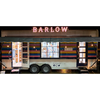
The iconic exterior of the custom-built Barlow trailer.
In 2019, Susan Charlet decided to open a Baton Rouge area clothing boutique, Barlow, which she had been dreaming of for a few years. She opened Barlow in a custom-built trailer, rather than in a brick-and-mortar store, which allowed it to open by April 2020. Barlow's custom trailer features a custom-built neon sign, nine-foot ceilings, antique pine hardwood floors, a hand-painted interior mural, and a custom vinyl wrap. While Barlow stocks women's clothing from brands like English Factory, THML, En Saison, AG Jeans, and Articles of Society, the success of the concept has been due, in part, to the novelty and experience of shopping in the trailer.
Barlow offers private events, which Susan Charlet has said they book far more often than expected, and they market the shopping experience through social media and through traveling to different festivals, fairs, and the Round Top Antiques show in Texas to increased awareness in the local region and beyond. The success of Barlow also works as Charlet continues to bring in items that appeal to her target demographics and stock items she feels are trendy and seasonal. Further, she and her husband expect to build a brick-and-mortar location for Barlow in the future.
The American Mobile Retail Association (AMRA) was created by the owners of Le Fashion Truck after the quick growth of their mobile fashion boutiques in 2011. The AMRA works to help mobile retail businesses through support and assistance, such as webinars and consulting services, and has provided advocacy services to educate public and city officials to the benefits of mobile retail and to assist mobile retailers in their business ventures. The services they offer can include tips and tricks on developing a specific type of business, ideas for businesses that could be created, and reporting on the state of the mobile boutique industry.