Title
The word Larix as a scientific name was introduced into the literature long before Carl Linnaeus, at the beginning of the XVI century.
Its origin is not entirely clear. Some authors believe that this is the Gallic name of the resin, or they produce it from the Celtic lar — abundant, rich (very resinous). According to others, this word comes from the Latin laridum, lardum - fat, because of the large resinous nature of the trees. Carl Linnaeus has this specific epithet, which Miller used as a generic name, separating larches from pines.
The Russian name "larch" is given by the behavior of this coniferous tree: every winter it (the only one in its family) drops needles like deciduous trees.
Distribution and habitat
It grows in temperate and cold (subarctic and subalpine) regions of Eurasia and North America. The most numerous and widespread tree species in Russia and in the world (by the number of woody specimens, as well as by the total forest area with its predominance): larch forests account for about 8% of the total forest area of the world. In terms of the vastness of the planetary area, larch is still inferior to such tree species as willow, alder, juniper, poplar, birch and pine. Despite the fact that the areas of forests on our planet, which are formed by each of the listed tree genera separately, are smaller than larch trees and they grow more disjointed, nevertheless these trees are distributed over most of the land compared to larch. In the USSR, the total area of larch forests formed by several species of larch was, according to various estimates and in different years, from 258 to 264.1 million hectares (approximately 38 to 40.6% of the total area of the country's forests), and the wood stock was over 26 billion m3. According to updated data, the area of larch forests in Russia is estimated at approximately 264 million hectares, their share in the total forested area remained almost at the same level, and the total wood stock in them is 23.1 billion m3 (2003). In addition to Russia, the natural range covers mountainous areas of several European and Asian countries. In nature, it is also quite widespread in Canada, less often in the northern states of the USA, including Alaska. Forms light-coniferous larch forests or grows in admixture with other trees.
Botanical description
Under favorable conditions, it grows up to 80 m in height with a trunk diameter of up to 1.5-2 m. It lives up to 300-400 years, larch trees up to 900 years old and more have been registered.
The crowns are loose, translucent by the sun, cone-shaped in young trees. With age, they acquire a rounded or ovoid, blunt-topped shape. With constant winds, one-sided-flag-shaped.
The needles are annual, soft. Flattened, bright green, located on elongated shoots spirally and singly, and on shortened ones - in bundles, 20-40 (50) pieces each. In autumn, the trees completely shed their needles.
Crown shape. Siberian larch in winter
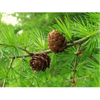
Larch is a monoecious plant. Male spikelets are round-ovate, yellowish, 5 to 10 mm long. Stamens with two anthers. Pollen without air bags. Female cones are reddish-pink or green. Pollination occurs simultaneously with the budding of needles or immediately after its budding, in the south - in April - May, in the north - in June. Cones ripen in autumn in the year of flowering, have an ovoid or oblong-rounded shape with a length of 1.5 to 3.5 cm. The seed scales are stiff, longer than the coverts. Mature cones open either immediately, or - after overwintering - in early spring. The seeds are small, ovoid, with tightly attached wings. Fruiting begins at the age of about 15 years. Abundant seed years are repeated at intervals of 6-7 years. Seed germination is low.
The root system of larch under normal conditions is powerful, branched, without a pronounced taproot, with strong lateral roots buried at the ends, the presence of which ensures the wind resistance of the tree. Sometimes there is rooting of branches in contact with the soil. In conditions of waterlogged soils, as well as with shallow permafrost, the root system is superficial. At the same time, trees suffer from wind. In floodplains of rivers, on moss swamps in conditions of deepening of the basal part of the trunk with a growing layer of mosses or introduction of a sandy-silty layer, larch forms adventitious roots.
Larch is an extremely light-loving tree. It resumes and grows best in full sunlight. It forms stands of mostly low closeness, through the canopy of which sunlight easily penetrates. For renewal, open, unshaded places are preferred. As a rule, for a long time (several decades), the undergrowth can develop successfully only with very little shading under the canopy of the mother stand. In favorable conditions, larch grows quickly. Up to the age of 20, she is able to add from 50 to 100 cm per year.
Larch Alley in Tsarskoye Selo
Larch is resistant to spring frosts, very resistant to low winter temperatures, extremely undemanding to the heat of the growing season — that is why it is widely distributed far beyond the Arctic Circle and high in the mountains.
It is also undemanding to the soil. It grows in moss swamps, waterlogged marshes, near permafrost, on dry skeletal soils of mountain slopes. In such unfavorable conditions, larch can be stunted and stunted. Optimal soils that give larch opportunities for the best development are moistened and well-drained loam or sandy loam soils of gentle slopes and river valleys.
In places unfavorable for other breeds — on heavy and waterlogged soils, in permafrost areas, on marys — it forms purely larch plantations. With the improvement of soil-climatic and hydrological conditions, it grows in a mixture with pine, spruce, cedar, fir, birch, and other species. It is well populated by burning and fresh unburned solid cuttings. Seedlings and natural undergrowth are almost not damaged by rodents