Other attributes
A K-line, or Knowledge-line is a mental agent that represents an association of a group of other mental agents found active when a subject solves a certain problem or formulates a new idea.
The theory and idea of a K-line was first described in Marvin Minsky's essay K-lines: A Theory of Memory, which was published in the journal of Cognitive Science in 1980. He explains how when a person forms an idea or solves a problem, they create a 'K-line', and this can be reactivated to resemble the original instance.
Minsky proposed that after a person forms an idea they wish to remember, and create a K-line, they can later activate the K-line which induces a "partial mental state". This partial mental state is a subset of mental agencies that operate at one moment. This idea is meant to deal with questions that are associated with theories of memory such as how information is represented, how it is stored, how it is retrieved, as well as how it is used. It also is meant to handle new situations and questions such as how are abstractions made, when are they stored (before or after), and how they are later instantiated.
The K-Line theory tries to deal with these questions through the thesis that the function of a memory is to recreate a state of mind. Minsky proposes the mind is composed much like a society and has many partial "agents" that act as a society of smaller minds. A partial mental state is therefor a subset of the states of the parts of the mind acting at once. Activating a K-node imposes a specific partial state inside the mental society by activating the agents connected to its K-line to induce a certain computational disposition.
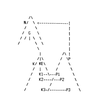
The theory proposes that within the mind there is a K-pyramid that is made up of K-nodes that can excite a collection of P-agents via its K-line. When a part of the mind (P) experiences a mental event (E) that led to achieving some goal (G) and another part of the mind considers it memorable, two things happen. The first is that a new agent called a K-node (KE) is created and is linked to G. The second is that every K-node forms a wire called its K-line to be make a connection to every agent in the P-pyramid. Memorizing causes the K-line to make an excitatory attachment to every currently active P-agent. A K-line shouldn't affect agents at levels too far below PE (P agents active during E), nor should it reach up to or above the level of PE itself. The K-line should span only a certain band of levels somewhere below PK.


