
Insectivorous plants (the terms carnivorous plants and carnivorous plants are also used) is the collective name of about 600 plant species from 19 families that have adapted to catching and digesting small animals, mainly insects. Thus, they supplement their normal autotrophic nutrition (photosynthesis) with one of the forms of heterotrophic nutrition. As a result, insectivorous plants are less dependent on soil inorganic nitrogen, which is necessary for the synthesis of their own proteins.
Insectivores are mainly perennial herbaceous plants found in all parts of the world. On the territory of the CIS there are 18 species from four genera belonging to two families: Rosy and Bubbly.
True insectivorous plants are believed to have evolved independently in five different groups of flowering plants.

Historical information and study
Insectivorous plants became known in the XVIII century[4. The very first accurate botanical description of the Venus flycatcher (Dionaea muscipula) was made by the English naturalist John Ellis in a letter to Carl Linnaeus in 1769. So, in this message, he first suggested that captured insects serve as food for plants .
In 1782, the German physician Albrecht Wilhelm Roth described the peculiar movements made by the leaves of the dewdrop to catch insects, and developed the Ellis hypothesis, according to which such plants feed on invertebrates.
Meal worm in venus fly trap.jpg
In 1791, William Bartram, in a book about his travels in the states of North America, described plants of the genus Sarracenia that had pitcher leaves for catching insects. He also used the term "carnivorous plants" for the first time.
At the beginning of the XIX century, a number of new genera and species belonging to this group of plants were described. Thus, Peter Willem Kortals in 1835 described the phenomenon of insectivore in plants of the genus Nepenthes (Nepenthes).
Soon there were works devoted to the in-depth study of the characteristics of such plants. In 1861, Auger de Lassu described the sensitivity to touch and movement of leaves of plants of the genus Aldrovanda. In 1868, the American scientist William Canby[es] first pointed out the digestive properties of the juice secreted by glands on the leaves of the Venus flycatcher.
The next stage in the study of insectivorous plants was the research work of Charles Darwin, which began with observations of dewdrops in 1860[6]. At the same time, Darwin set up a number of laboratory experiments that turned into research. He studied the "tastes" of plants and compiled their "menu". Darwin's special attention was attracted by the ability of plants to digest food, their grasping movements, high sensitivity to touch - that is, properties similar to those of animals. Subsequently, these experiments became a serious scientific work, which incorporated many unique observations and bold, but reasonable conclusions.
This work so captured Darwin that in a letter to Layel he confessed:
Currently, Drosera interests me more than the origin of all species in the world.
Darwin was hesitant to publish the results of his research for a long time. Only 15 years later, when they were supplemented by other researchers, he published the book "Insectivorous Plants" (1875)[6]. The second edition of Insectivorous Plants, with large additions written by his son, was published after Darwin's death, in 1888[4].
Charles Darwin's work was a turning point in the research of insectivorous plants. As K. Goebel writes (1893),
hardly any other department of botany in recent times has attracted the attention of wider circles than the so-called insectivorous plants. The reason for this was especially the extensive work of Darwin, which gave rise to the appearance of numerous other works[4].
However, this work did not immediately find recognition among scientists of its time and was severely criticized, in most cases because of their fundamental differences with Darwin's new evolutionary theory. Director of the St. Petersburg Botanical Garden E. Regel (1879) expressed the opinion that Darwin's statement about the existence of insectivorous plants in nature belongs to the number of theories,
which any sane botanist and naturalist would simply laugh at if it did not come from the illustrious Darwin. We hope that the cold mind (der kuhle Verstand) and the thorough observation of our German researchers will soon throw this theory, like the theories of primary origin, parthenogenesis, alternation of generations, etc., into a box of scientific junk, which the former followers of such theories themselves are the least willing to ever open.
However, so far Darwin's fundamental work is the largest contribution to the study of insectivorous plants.

Evolution
One of the first insectivorous plants Archaeamphora longicervia from the family Sarraceniaceae (reconstruction from a fossil imprint)
Data on the evolution of insectivorous plants are extremely scarce due to the small number of fossils of the latter. Fossils, most of which are represented by seeds or pollen, have not been found enough. Most representatives of insectivores, being herbaceous plants, are devoid of dense structures such as bark or wood, and the trapping formations themselves probably have not been preserved as fossils.

Botanical description
Insectivores are mainly perennial herbaceous plants, but semi-shrubs and small shrubs are also found.
The largest known insectivorous plant is Byblis gigantea, a small (up to half a meter) shrub from the Byblis family, native to Australia. It comes across not only insects, but also snails and even frogs and lizards. Nepenthes - tropical vines with a woody stem, grow up to 4 m in length (winged Nepenthes). There are species of nepenthes that attract small mammals with nectar and use their excrement as fertilizers.
They live mainly in swampy meadows and swamps, in the water of fresh reservoirs. Rosolist (Drosophyllum), a semi-shrub up to 30 cm tall, growing on dry sands in North Africa and the Iberian Peninsula. Local peasants have long used this plant instead of sticky paper from flies, hanging it inside houses.
Animals are used as an additional source of phosphorus, potassium and other elements. Insects are caught with the help of modified leaves - catching organs. Attract insects by coloring, smell or sweet secretions. On the surface of the leaves there are glands that secrete digestive enzymes: pepsin and organic acids (formic, benzoic and others), which digest the caught victim, splitting animal proteins. The products formed as a result of such extracellular digestion, mainly amino acids, are absorbed and assimilated.
The root system of terrestrial insectivorous plants is poorly developed, in aquatic plants it is usually reduced. However, all such plants can exist due to substances absorbed from the soil or water. Additional nutrition with animal food accelerates the development of plants, promotes their transition to flowering and fruiting.
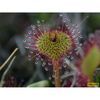
One of the types of dewdrop digesting a fly.

Distribution
Insectivorous plants are found in all ecosystems where flowering plants can grow - from the Arctic to the tropics and from sea level to the alpine belt of mountains. They are known on all inhabited continents, with a predominant distribution in areas with warm, temperate and tropical climates.
The following insectivorous plants grow wild on the territory of Russia and neighboring countries:
Two species of the genus Dewdrop (Drosera), growing on peat (usually sphagnum) marshes— are round-leaved dewdrop, or common (Drosera rotundifolia) and English dewdrop, or long-leaved (Drosera anglica).
Aldrovanda vesiculosa (Aldrovanda vesiculosa). An aquatic plant, it is found in the central regions of the European part of Russia, in the Caucasus and the Far East of Russia.
Four species of the genus Pemphigus (Utricularia). They are found almost all over the country (with the exception of the regions of the Far North) in ditches, swamps, in shallow places of ponds and lakes.
Six species of the genus Zhiryanka (Pinguicula). They are found along the banks of streams, on sphagnum swamps, some as epiphytes on mosses and trees.

Mechanisms and types of traps
Fishing mechanisms
One of the types of dewdrop digesting a fly
All insectivorous plants can be divided into two groups according to the mechanism of catching[8]:
actively catching — with actively moving organs for catching insects (dewdrop, flycatcher);
passively catching;
with mucous and sticky secretions on the leaves, catching insects (rosolist, zhiryanka);
with pitcher traps, bubbles and the like (pemphigus, nepenthes, genlicia, sarracenia).
Types of traps
Plants use five main types of traps to catch prey[8]:
hunting leaves in the shape of pitchers;
leaves that close in the form of traps;
sticky traps;
sucking traps;
a crab claw type trap.
The type of trap does not depend on the plant belonging to a particular family.
Loss of Predation
Nepenthes pitcher is well adapted for capturing dead foliage
Many plant species can be classified as protonasecomivorous or paranasecomivorous. Proton-insectivorous plants are called plants that can extract the nutrients they need from insects stuck to their surface [9]; however, unlike insectivorous plants, they lack special trapping devices and do not have an attractive smell and secretory glands. Protosecomivore is common for plants with glandular pubescence (yellow ibicella, some species of laptlets, geraniums) and sticky stems (tar). Paranasivorous plants have partially lost the ability to catch and digest small animals and in the course of evolution have adapted to use other sources of nutrients. One of these plants is Nepenthes pitcher (Nepenthes ampullaria), which, along with attracting, catching and digesting arthropods, has the ability to obtain nutrients from the falling leaves of other plants that fall into its hunting "pitcher"[10]. Another example is Nepenthes lowii. Preliminary studies have shown that this species has presumably adapted to "catching" the droppings of birds feeding on its nectar and sweet secretions. Nepenthes attenborough (Nepenthes attenboroughii), native to the Philippines, synthesizes sweet nectar on the lid of a jug. This nectar is loved by small animals — tupayas, who use these pitchers as a toilet. From animal feces, the insectivorous plant receives nitrogen and phosphorus — and produces a new portion of the attracting nectar, completing the cycle .
The purple pemphigus (Utricularia purpurea) has partially lost its ability to catch prey. At the same time, it has developed mutualistic relationships, providing its bubbles for algae and zooplankton habitat.


