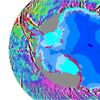
Gravimetry is a field technique that measures variations in the Earth's gravitational field. These variations are caused by density contrasts near surface rock and sediment. The surveys are carried out by sensitive instruments, known as gravimeters, which are capable of measuring variations in the gravitation field. These measurements are accompanied by topographic surveys. There are a variety of applications for gravimetry:
- Regional geological mapping
- Detection of karsts and voids
- The determination or improvement of terrestrial geoid
- Oil and gas exploration
- Mineral exploration
- Measurements of sediment thickness
- Archeological surveys

Use of a gravimeter for a gravimetric survey.
Gravimetry is capable of measuring the variation in gravitational acceleration felt near the Earth's surface. The variations can occur due to the change and attraction between the mass inside and around the Earth, centrifugal effects from Earth's rotation, the mass distribution in the Earth's interior, and the position of the Earth relative to the moon, the sun, and the other planets. Monitoring these changes can provide information on tectonic deformations, past and present ice-mass changes, tides, the dynamics of oceans, and the hydrosphere and structure of the Earth.
Gravimetry and a gravimetric survey can also offer industry information on variations in soil density and expose the presence of a deficit or an excess of mass with respect to a regional gradient. A gravimetric survey can be an essential part of developing a 3D geological model of an area.
Gravimetry and gravimetric surveys can be performed from aircraft and are an essential part in geodesy, geophysics, and exploration. This method fills the gap between satellite techniques and traditional ground measurements. Satellite techniques often have low spatial resolution, while traditional ground measurements can only be performed in accessible areas. Airborne surveys enable access to areas inaccessible by foot and better spatial resolution than satellite techniques. They offer regional gravity mapping and can cover large areas in a relatively short time. This is especially useful on coastal areas. Most airborne gravimetry is performed using relative sensors, which can be a drawback due to the required calibration and drift estimation procedures. These procedures both introduce operational constraints and possibilities for measurement errors.
However, there are designs for absolute airborne gravimeters based on atom interferometry. These sensors have been used for gravimetric surveys across Iceland in April 2017. During this time, the sensors had an estimated error between 1.7 and 3.9 mGal. And, compared to upward continued ground gravity data, the differences were within standard deviation, ranging from 3.3 to 6.2 mGal and with a mean value ranging from -0.7 to -1.9 mGal.
There are two types of satellite surveys for gravimetry. The first is satellite altimetry, which can estimate the gravity field and geoid over the ocean; it is subject to various errors and temporal-spatial resolutions. The second is satellite-based laser ranging of artificial satellites. Because the satellite orbital motion is largely affected by gravitational forces and other non-conservation forces, orbit solutions based on satellite tracking observations can estimate the gravity field. However, this method only provides long-wavelength gravity field information. A combination of methods, including satellite gravimetry survey methods, can offer comprehensive gravity field models.
Due to the increase of low-Earth orbit satellites and related gravimetry, the survey accuracy has increased in both precision and temporal-spatial resolution. These satellites can use satellite-to-satellite tracking (SST) and satellite gravity gradiometry (SGG) techniques in order to estimate the global gravity field and its variations. The SST technique includes the high-low satellite-to-satellite tracking (hl-SST) and low-low satellite-to-satellite (ll-SST), which can each determine the variation rate of the distance between two satellites. Meanwhile, SGG techniques use a gradiometer carried on low-orbit satellites to determine the second order derivatives of gravity potential, which can recover the Earth's gravity field.
Marine gravimetry has been a standard gravimetry since the 1960s. Attempts at marine gravimetry had been made in the 1920s and 1930s prior to that, where gravimetric devices were carried on-board submarines. However, these marine measurements were not as accurate as terrestrial measurements.

Example of a marine-based gravimetric system.
At sea, a gravimeter is subject to the accelerations of the vessel, and these effects have to be accounted for if any precision is expected. This can be done by modeling and removing the effects of vessel acceleration, although the unpredictability of bodies of water can complicate these processes. The use of multi-antenna global navigation systems in conjunction with inertial measurement units comprised of accelerometers and gyroscopes can accurately measure vessel acceleration, and, in turn, increase the accuracy of gravimeters in kind.
In correcting for a vessel's acceleration and the wave-induced vessel motion, the gravimetric surveys can be increased in accuracy and can begin to reach similar levels of accuracy as terrestrial measurements. This accuracy can be increased again when used in conjunction with satellite and airborne gravimetric surveys.
A microelectromechanical system (MEMS) gravimeter can offer a sensitivity of 40 ppb with an integration time of one second. The sensor has been used to measure Earth tides. And since this time, the MEMs gravimeter has been miniaturized and field-tested to demonstrate the accuracy of gravitational accelerations measured while going up and down a lift of a shaft. These tests suggested the device had use as a field-portable instrument, as the total package size is similar to a smartphone.
MEMs devices are found in most smartphones and can be mass-produced at low cost. With a little extra care and cost, gravimeter-sensitive MEMs devices can be manufactured with a low cost and a relatively small size. This device can increase the applications of gravimeters, including the capability to be mounted on a drone instead of low-flying aircraft for distributed land surveying and exploration, to be deployed to monitor volcanoes, or to be built into multi-pixel density-contrast imaging arrays.