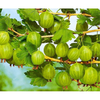

Gooseberry is a popular garden plant that has a strong tonic effect. It is widely used in cooking, dietetics, folk medicine. Ripe fruits are famous for their delicate taste, as well as anti-inflammatory and diuretic properties.
advertisement
Distribution, description
Gooseberry is a small shrub (up to 1.5 m) with thin prickly branches. The plant belongs to the gooseberry family, the genus is currant.
It has delicate leaves (like celery) and very tasty, healthy fruits – sweet, juicy, with a pleasant sourness. Sometimes they have a noticeable down or thin spikes, more like hairs. Beautiful streaks are often visible on the surface.
On the territory of the Krasnodar Territory, gooseberries bloom in March or April, and ripen in the second half of June. In the northern regions, the deadlines are shifting. The plant feels good in a temperate climate.
Berries of different varieties differ in color, shape, taste characteristics. The size ranges from 0.5 cm to 300-400 mm. Color - from pale green
Until the beginning of the 20th century, gooseberries were widespread, until they were almost destroyed by an infection imported from the American continent. Then the breeders brought out new varieties, the culture was restored.
advertisement
At the moment, more than one and a half thousand varieties of gooseberries are known. Today it is one of the main berry bushes, which is grown everywhere.
When the gooseberry got to America, it was struck by powdery mildew. The varieties imported from Europe died. Breeders brought out new, more stable ones, but the reputation of the plant was "tarnished".
Up until the 60s, gooseberries were outlawed in the USA. Then some states succeeded in lifting the ban, but popularity never returned to it. The almost complete absence of information about the plant in the English-speaking segment of the Internet is striking.
In our country, only lazy people do not grow gooseberries (if there are several square meters of free land). It is unlikely that there is at least one summer resident who has not attached a couple of seedlings to his plot.
Gooseberries are the leaders among berries in terms of the content of useful vitamins and minerals. It is rich in ascorbic acid, B vitamins. It contains salts of phosphorus, iron, and other macro- and microelements
The beneficial properties and contraindications of gooseberries are due to the presence of these elements. Each of them plays an important role:
Ascorbic acid does not need advertising. There is 2.5 times more of it here than in cherries, and one and a half times more than in blueberries.
Potassium is necessary for the normal functioning of the heart. It relieves swelling, helps to reduce blood pressure, normalize the heart rate.
The combination of Mn and Cu improves blood composition.
Silicon means healthy joints, beautiful skin, nails, and hair.
Molybdenum prevents the teeth from breaking down, prevents the development of gout. Gooseberries contain more of this element than spinach, watermelon or melon.
Dark fruits are rich in anthocyanins - natural pigments with high biological activity. There is a lot of rutin in colored fruits, which enhances the action of ascorbic acid and increases the elasticity of capillaries.
And gooseberries are a source of pantothenic acid. It supports the functioning of the nervous system, improves the lipid profile, reduces the deposition of cholesterol plaques on the walls of the vessel
How is gooseberry useful for the human body?
The medicinal properties of gooseberries are well studied. Yellow or emerald berries quickly restore strength after overwork, stress, injuries and infectious diseases. They have an impressive list of healing properties:
strengthen the immune system,
activate metabolism,
normalize digestion,
protect against anemia,
increase hemoglobin,
remove excess cholesterol,
relieve constipation,
block the aging process,
help the liver,
normalize blood pressure.
Fresh berries and decoctions of them have a mild diuretic and choleretic effect. Young leaves are no less valuable raw materials. They are added to tea or brewed separately. The infusion has healing power:
stabilizes the hormonal background,
prevents the formation of kidney stones,
breaks down fat cells,
promotes weight loss,
improves blood circulation,
inhibits the development of atherosclerosis.
Home " Products " Fruits and berries " Gooseberry: what is useful for "northern grapes"?
Gooseberry: what is useful for "northern grapes"?
09.07.2020 · 1 · All entries for July 2020
Red gooseberry
Greetings to the readers of 100Polezno! Summer is in full swing and pleases us with delicious gifts. Let's discuss gooseberries today: what is useful, what healing power is hidden in it, how to cook and preserve it.
Hide content
1. Distribution, description
2. A little about the history of gooseberries
3. Chemical composition of gooseberry berries
4. What is the use of gooseberries for the human body?
5. How to choose and save?
6. The use of gooseberries
Gooseberry is a popular garden plant that has a strong tonic effect. It is widely used in cooking, dietetics, folk medicine. Ripe fruits are famous for their delicate taste, as well as anti-inflammatory and diuretic properties.