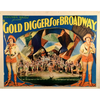
The term gold-digger was a slang term that has its roots among chorus girls and sex workers in the early 20th century. In print, the term can be found in Rex Beach's 1911 book, The Ne'er-Do-Well, and in the 1915 memoir My Battles with Vice by Virginia Brooks. The Oxford Dictionary and Random House's Dictionary of Historical Slang state the term is distinct for women because they were much more likely to need to marry a wealthy man in order to achieve or maintain a level of socioeconomic status.
The term gold digger rose in usage after the popularity of Avery Hopwood's play The Gold Diggers in 1919. Hopwood first heard the term gold digger in a conversation with Ziegfeld performer Kay Laurell.

The Gold Digger (Judge, 24 Jul 1920)
As an indication on how new the slang term was, Broadway producers urged him to change the title because they feared that the audience would think that the play was about mining and the Gold Rush.
Several women were perceived as exemplars of the gold digger stereotype by the public. The best known gold digger of the early 20th century was Peggy Hopkins Joyce. Joyce was a former show girl who married and divorced millionaires. She was characterized as a gold digger during her divorce battle with Stanley Joyce during the early 1920s. Some have argued that she was the real-life inspiration for Lorelei Lee, the protagonist in Anita Loos’ 1925 gold digger novel Gentlemen Prefer Blondes and some have contended that the term gold digger was coined to describe her. Former Olympian Eleanor Holm was dubbed the "swimming gold digger" for her divorce contest with Broadway impresario Billy Rose during the 1950s. The press and public described model and actress Anna Nicole Smith as a gold digger for marrying multi-millionaire octogenarian J. Howard Marshall II.
Sharon Thompson's research has demonstrated how the gold digger stereotype or image has been used against women in the negotiation of alimony cases. The gold digger stereotype was also deployed in public discussions about "heartbalm" legislation during the 1930s, particularly breach of promise cases. The popularity of the gold digger image was a contributing factor to the nationwide push to outlaw heart balm laws in the middle and late-1930s in the United States.
The gold digger emerged as a dominant trope in American popular culture beginning in the 1920s. Stephen Sharot stated that the gold digger supplanted the popularity of the vamp in 1920s cinema.
By the 1930s, the term gold digger had reached the United Kingdom because British film industry made a remake of The Gold Diggers. While the film has been disliked by critics, several sequels with the same title have been made.
In the 1930s, the gold digger trope was used in a number of popular American movies, most notably Gold Diggers of 1933, Gold Diggers of 1935, Baby Face, Red-Headed Woman, Dinner at Eight, and Havana Widows. Film historian Roger Dooley notes that the gold digger is one of the most common of the “stock company of stereotypes that continually reappear in the films of the 1930s.” Gold diggers in 1930s cinema were often portrayed in positive, sometimes heroic, ways. The character has featured in many films since the 1930s such as Gentlemen Prefer Blondes (1953) and How to Marry a Millionaire (1953), both starring Marilyn Monroe, or as a villainous foil, as in both versions of Disney's film The Parent Trap.
The gold digger image or trope appears in several popular songs, including "My Heart Belongs to Daddy" (1938), "Diamonds Are a Girl’s Best Friend" (1949), "Santa Baby" (1953), "She Got the Goldmine (I Got The Shaft)" (1982), and "Material Girl" (1984). Rap music's use of the "gold digger script" is one of a few prevalent sexual scripts that is directed at young African-American women. For example Kanye West's "Gold Digger" and EPMD's "Gold Digger" both references a woman marrying for perceived wealth.