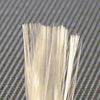

Glass fiber is a material comprised of numerous extremely fine fibers of glass. The most common form is made of silicate glass, silica, or silicon dioxide, with other oxides or impurities that can change the color and properties of the glass. Glass fibers are an extremely versatile industrial material with mechanical properties comparable to other fibers, such as carbon fiber and polymers. Glass fiber has many applications, including making materials for thermal, electrical, and sound insulation; for heat- and corrosion-resistance; and as a reinforcing agent for a number of industries, including construction. Glass fiber is used as a reinforcing agent for polymer products, forming a durable and lightweight material known as fiberglass. Glass fibers can be comprised of various types of glass. When flattened into a sheet, the glass fiber is randomly arranged or woven into a fabric.
Also called glass fiber-reinforced plastic or glass-reinforced plastic, the thickness, weight, and structure of fiberglass offers advantageous properties leading to use in many industrial applications. Although the strength of fiberglass is lower than carbon fiber, it requires significantly cheaper raw materials and is less brittle. Fiberglass can also be molded into different shapes and is widely used in a number of industries, including construction, civil engineering, commercial and residential products, aircraft, roofing, and sporting equipment.
Making glass into small fibers has been around for thousands of years. The ancient Phoenicians, Egyptians, and Greeks experimented with glass, making it into small fibers for decoration. Typically this was only in small quantities, and the fiber produced was very coarse. Producing large quantities of glass fiber was significantly harder. Many people attempted to mass-produce glass fibers in the nineteenth century, and the first US patent for the production of glass fiber was issued to Hermann Hammesfar in 1880. The patent was purchased by Libbey Glass in Toledo, Ohio, which produced a dress made from the cloth displayed at the 1893 World's Fair in Chicago. Weighing 13.5 pounds, the dress was for demonstration purposes only and tended to break when folded. The mass production of glass fibers began in the 1930s and glass fiber products were separated into four main categories: chopped strands, direct draw rovings, assembled rovings, and mat products.
Glass fibers can be comprised of many types of glass, usually denoted by the following letters:
- A-glass—close to window glass in composition
- C-glass—glass with higher resistance to chemical impact
- D-Glass—heat and thermal shock-resistant borosilicate glass
- E-glass—a combination of C-glass characteristics with good insulation to electricity; E-glass is a calcium alumino-borosilicate glass containing less than 1% alkali calculated as Na2O
- AE-glass—alkali-resistant glass
- ECR-glass—electronic glass fiber with a good waterproofing ratio, high mechanical strength, electrical acidic and alkali corrosion resistance. It shows better properties than E-Type glass fiber. The biggest advantage is a more environmentally friendly glass fiber.
- AR-glass—alkali-resistant glass specially designed for concrete construction
E-glass is the most commonly used glass fiber. Other types with trade names such as R-glass, S-glass or T-glass fibers exist with potentially better tensile strength than E-type glass fiber.
- High tensile strength
- Dimensional stability
- High heat resistance
- Good thermal conductivity
- Great fire resistance
- Good chemical resistance
- Outstanding electrical properties
- Dielectric permeability
- Compatibility with organic matrices
- Great durability
- Non-rotting
- Highly economical
Glass fibers have a high ratio of surface area to weight. However, this higher surface area makes glass fibers more susceptible to chemical attack. By trapping air within them, blocks of glass fiber make good thermal insulation, with a thermal conductivity of the order of 0.05 W/(mK). Glass fibers have good mechanical properties, including less fragility, extreme strength, less stiffness, and more lightweight. The physical and mechanical properties of a range of glass fiber types are shown below.

The physical and mechanical properties of a range of glass fiber types.
There are a number of glass fiber manufacturing processes:
- Continuous filament process
- Staple fiber process
- Glass fiber production
- Nozzle drawing
- Nozzle blowing
- Rod-drawing