
Person attributes


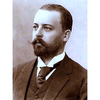
Fyodor Osipovich Schechtel (August 7, 1859 – July 7, 1926) was a Russian architect, graphic artist and stage designer, the most influential and prolific master of Russian Art Nouveau and late Russian Revival architecture.
Baptised as Franz Albert Schechtel (also transliterated as Shekhtel), he created most of his work as Franz Schechtel, changing his name to Fyodor with the outbreak of World War I. In two decades of independent practice he completed five theaters, five churches, 39 private residences, Yaroslavsky Rail Terminal and various other buildings, primarily in Moscow. Most of his legacy survives to date.
Biography
Early life
Franz Schechtel (Russified as Fyodor Osipovich) was born to a family of ethnic German engineers in Saint Petersburg, the second of five children. His parents were Volga Germans of Saratov. His mother, born Daria Karlovna Zhegin, came from a family of Saratov merchants. Schechtel's uncle on his father's side, also named Franz Schechtel, was an established businessman in Saratov. He is credited with building the first theater in Saratov. See also a photocopy of the Schechtel family tree.
The Schechtel family relocated to Saratov in 1865 to assist the ailing Franz Sr. in business. Both brothers, Franz Sr. and Osip, died in 1867. Business debts ruined their families, forcing Daria Karlovna to seek free boarding schools for the children; she relocated to Moscow and worked for Pavel Tretyakov. Franz attended a free Roman Catholic seminary in Saratov, graduating in 1875. However, he received his high school diploma only in 1880, when he was drafted into the Russian Imperial Army (Schechtel was eventually relieved from service).
Death and legacy
The advent of World War I in 1914, which halted practically all new construction for a decade, brought an end to Schechtel's professional career. His last work before the revolution was a wooden tented church in the Moscow suburb of Solomennaya Storozhka, funded by the Tula Militia training camp. Schechtel modelled the church on historical Olonetz area models (excluding the integrated belfry, which was uncommon for Olonetz architecture). The church was closed in the 1930s, neglected and eventually demolished in the 1960s; a wooden replica was built in 1996-1997. Schectel's only post-1917 work, a pavilion at the 1923 All-Russia Agricultural Exhibition, met a similar fate.
Shechtel cooperated with various planning and design agencies, continued teaching at Stroganov School of Arts and VKhuTEMAS, and even applied to the 1925 Lenin Mausoleum contest (Schechtel's entry), but did not build anything anymore. Construction in the USSR, halted by a decade of hostilities, resumed in 1926, the year of Schechtel's death.
In 1918, the architect was evicted from his house on Bolshaya Sadovaya and had to live with his daughter, Vera Tonkova (née Schechtel). Of Schechtel's four children, two of them — Vera Tonkova and Lev Zhegin — would become well-known artists. According to several accounts, however, Schechtel died in bitter poverty. He was interred at Vagankovo Cemetery.
Schechtel's Art Nouveau was despised by Soviet critics as rotten formalism until the Brezhnev period. At the same time, his Neo-Russian structures, such as Yaroslavsky Terminal, which matched the patriotic Soviet rhetoric quite well, were at first tolerated and later praised. Many of his Moscow mansions were leased to foreign embassies, have been well maintained and are still in good order inside and out. His public buildings, including his theaters and the Taganrog Library, also remain close to their original design externally.