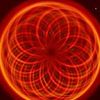
For its operation it uses a thin film of ferrofluid encapsulated inside a lens, similar to a Hele-Shaw cell filled with ferrofluid. Usually the ferrolens is fitted with an LED strip light programmable source on its periphery emulating different lighting conditions. The superparamagnetic nanoparticles inside the ferrofluid are following the magnetic flux of an external field induced in the ferrolens. At the same time, the oriented and aligned with the magnetic field lines nanoparticles, are emitting back part of their incident light thus essentially allowing them to "paint" the magnetic field lines and therefore making them visible. Light intensity and color texture of the field lines shown can vary slightly accordingly to magnetic field strength and direction.
A ferrolens has advanced visualization capabilities in detail, spatial resolution, sensitivity, color information and can depict also depth of field information on an observed magnetic field essentially making it a 3D holographic nanomagnetic direct observation passive device for magnetic fields and related quantum effects. Also when the ferrolens is used with a LED light strip, it shows the wire-frame model of the individual magnetic flux lines of a static magnetic field. Currently, it is the only device, reported by academia of this type which can efficiently visualize fast changing (i.e. dynamic) magnetic fields and its superparamagnetic properties is allowing it to display the quantum field of magnets.
Further academic research is being carried out one these type of devices for the polarization of light using magnetic fields. A ferrolens is not to be confused with a FLCD display device, since its technology, operation and applications are different.
Ferrolenses are available today mainly for research applications and education in general, under the registered trademark Ferrocell as a patented product.


