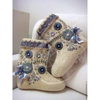

Felt boots - warm felt boots made from a mixture of felted sheep and wool of other animals. This is the traditional footwear of the peoples of Eurasia, which is used for walking on dry snow.
Wool fibers have an upper scaly layer - the cuticle, thanks to which the fibers can adhere to each other under the influence of hot water and steam. This is the principle of felting. The process of making boots is quite lengthy and requires certain skills. In handicraft production, the raw material for the manufacture of felt boots is usually sheep wool, or pieces taken from sheep in the summer. First, it is freed from impurities - blades of grass, thorns - and broken, turning into a soft and fluffy mass. The more castings in felt boots, the softer they are. A future model is molded from loosened wool, carefully making sure that the walls of the felt boot come out of the same thickness. Where the walls were thinner, they were patched up by adding thin woolen patches.

After a seamless model of the future felt boots is formed, it is wound on a rolling pin, which looks like a four-sided stick, and rolled, rolled or rolled for a long time. From here comes another name for this shoe, common in Siberia - wire rod. The rolling process is alternated with soaking for greater compaction and shrinkage of the wool.
Only after such a procedure, the felt boot is put on a collapsible wooden block and corrected with a wooden hammer. Then the surface of the boots is rubbed with pumice stone and placed in an oven to dry. For final processing, the dried boots are once again rubbed with pumice stone or a wooden block.
In addition to this conventional technology, there were many different secrets of making felt boots. So, alum, blue vitriol and blue sandalwood were used to blacken the felt, and white mixed with fresh milk was used to lighten the felt. The resulting mixture was rubbed to dryness into felt and placed in a slightly heated oven "for a free spirit."

Traditionally, boots are brown, black, gray and white, but in recent years, boots of various colors (red, blue, purple and others) have been produced by order of consumers. Also, a wide variety of experiments are still being carried out with felt boots - they are polished, ground and even varnished, having previously soaked the felt with carpentry glue. To achieve water resistance, use rubber dissolved in gasoline. Finishing and forms of felt boots are very diverse.