Other attributes
Foundation
The Elliott Wave Principle posits that collective trader psychology, a form of crowd psychology, moves between optimism and pessimism in repeating sequences of intensity and duration. These mood swings create patterns in the price movements of markets at every degree of trend or time scale.
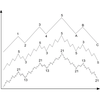
In Elliott's theory, market prices alternate between an impulsive, or motive, phase, and a corrective phase on all time scales of trend, as the illustration shows. Impulses are always subdivided into a set of five lower-degree waves, alternating again between motive and corrective character, so that waves 1, 3, and 5 are impulses, and waves 2 and 4 are smaller retraces of waves 1 and 3, respectively. Corrective waves subdivide into three smaller-degree waves starting with a five-wave counter-trend impulse, a retrace, and another impulse. In a bear market the dominant trend is downward, and the pattern is reversed—five waves down and three up. Motive waves always move with the trend, while corrective waves move against it.
Wave degree
The Elliott Wave Principle states that markets grow from small price movements by linking Elliot wave patterns to form larger five-wave and three-wave structures that exhibit self-similarity, applicable on all timescales. Each level of such timescales is called the degree of the wave, or price pattern. Each degree of waves consists of one full cycle of motive and corrective waves. Waves 1, 3, and 5 of each cycle are motive in character, while waves 2 and 4 are corrective. The majority of motive waves assure forward progress in the direction of the prevailing trend, in bull or bear markets, but yielding an overall principle of growth of a market.
The overall movement of a wave one degree higher is upward in a bullish trend. After the initial five waves forward and three waves of correction, the sequence is repeated on a larger degree and the self-similar fractal geometry continues to unfold. The completed motive pattern comprises 89 waves, followed by a completed corrective pattern of 55 waves.
Each degree of a pattern in a financial market has a name. Practitioners use symbols for each wave to indicate both function and degree. Numbers are used for motive waves, and letters for corrective waves (shown in the highest of the three idealized series of wave structures or degrees). Degrees are not strictly defined by absolute size or duration, by form. Waves of the same degree may be of very different size or duration.
While exact time spans may vary, the customary order of degrees is reflected in the following sequence:
Grand supercycle: multi-century
Supercycle: multi-decade (about 40–70 years)
Cycle: one year to several years, or even several decades under an Elliott Extension
Primary: a few months to two years
Intermediate: weeks to months
Minor: weeks
Minute: days
Minuette: hours
Subminuette: minutes
Some analysts specify additional smaller and larger degrees.