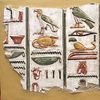
Other attributes
The word "hieroglyph" is derived from the Greek hieros (sacred) and glypho (inscriptions). Ancient Egyptians believed that the god Thoth invented writing. They called their hieroglyphic script mdju netjer, meaning "words of the gods." In Egypt, the earliest known examples of writing are dated to 3,400 BC. The latest dated inscription in Egyptian hieroglyphs was on the gate post of a temple at Philae in 396 AD.

Hieroglyphs were utilized primarily for formal inscriptions on the walls of temples and tombs. The script is detailed and in full color in some inscriptions; in others, they are simple outlines. For daily writing, the hieratic script was utilized. Hieroglyphs are read in columns from top to bottom or in rows from the right or left.
Egyptian hieroglyphs are composed of three basic kinds of signs: logograms that represent words; phonograms that represent sounds; and determinatives, which are situated at the end of the word to assist with meaning clarification. This means that the number of signs utilized by the Egyptians was higher than alphabetical systems, since about a thousand different hieroglyphs were used, which was later reduced to about 750 during the Middle Kingdom (2055-1650 BCE).
Like many ancient scripts, the origin of Egyptian hieroglyphs has several hypotheses. One of the most common views is that they come from rock pictures produced by prehistoric hunting communities residing in the desert west of the Nile, who knew how to communicate via visual imagery. Some of the motifs on these rock images are found on pottery vessels of early pre-dynastic cultures in Egypt.
This is especially marked during the Naqada II period (c. 3500-3200 BCE). In Abydos' cemetery U, tomb J, a member of the local elite was buried around 3100 BCE. He was thought to be wealthy, probably a ruler, and was buried with different goods, including hundreds of jars and an ivory scepter. Many of the objects were taken, and knowledge of them is due to the approximately 150 surviving labels, which contained the earliest known writing in Egypt.

Naqada II Pottery: Guillaume Blanchard
Ancient hieroglyphs date from the end of the fourth millennium BCE and comprised annotations on pottery jars and ivory plaques. These were deposited in tombs, presumably to identify the dead. Not all of the early signs could be read, and it is presumed that these forms are based on the same system as the later classical hieroglyphs.
In certain cases, it is deduced that it is not the copied object that is designated; rather, another word that is phonetically similar to it. This means that hieroglyphs were phonetic symbols. An earlier stage consisting of picture writing with actual illustrations of the intended words cannot be shown to have existed in Egypt.
Development from pictures to letters did not seem to take place, and hieroglyphic writing was not just a system of picture writing. The signs on the bottom of clay vessels that occur at roughly the same period do not represent a primitive form of the script. These designs developed in parallel fashion to hieroglyphic writing and were influenced by it.
In AD 391, the Byzantine Emperor Theodosius I closed pagan temples throughout the empire. This ended a four-thousand-year-old tradition, and the message of the ancient Egyptian language was lost for 1500 years. It was later renewed when the Rosetta stone was discovered and through the work of Jean-Francois Champollion (1790-1832).
There was also a decimal system of numeration up to a million. The early picture forms were not discarded or simplified, and it is assumed that it was because they were aesthetically appealing. Hieroglyphs were used mainly by the priests.
The drawn symbols decorated the walls of temples, but for day-to-day business, the hieratic script was used. This was a handwriting in which the picture signs were abbreviated to the point of abstraction. The direction in which hieroglyphs are to be read can be distinguished because the human or animal figures face towards the beginning of the line. The upper symbols are also read before the lower ones.

The hieroglyphic sign for "write" was made from an image of the scribal palette and brush case. Statues of scribes are often shown with a papyrus across their knees and a palette, which was the scribe's trademark, over one shoulder. From the late Old Kingdom and beyond, the basic palette was created from a rectangular piece of wood, with two cavities at one end for holding cakes of black and red ink.
Carbon was utilized to make the black ink and iron-infused red ochre to make the red. The pigments were combined with gum to congeal rather than turn to dust after drying. The cakes of ink were dampened with a wet brush, and the brush pens were made from rushes—the tip slashed at an angle and chewed to separate the fibers.
The colors were stored in a slot in the center of the palette. Black was the standard color for writing, while red was utilized for marking the beginning of a text. Red was also used to highlight certain words and phrases, such as medicine quantity or the names of demons in religious papyri. Other colors were required for illustrations, such as those in the Book of the Dead.