Other attributes
Chickenpox is highly contagious. The virus is transmitted through direct contact with a carrier. Children often get sick in whole groups (groups in kindergarten or classes at school). Chickenpox is an acute infectious disease characterized by a profuse itchy rash on the skin and mucous surfaces. It does not appear immediately: the incubation period can be from 10 days to 3 weeks.

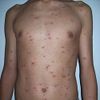
Child with chickenpox
The causative agent of chickenpox is the varicella-zoster virus, lat. Varicella Zoster of the Herpesviridae family, another name: human herpes virus type 3 (Human herpesvirus 3), also known as "herpes zoster". Along with chicken pox, it is the causative agent of herpes zoster (shingles).
People of all ages are susceptible to the disease, mainly children are ill. Recurrent illnesses are extremely rare, however, in 10-20% of those who have been ill, the virus remains inactive in the nervous tissues of the body and can cause shingles in the future.
In most cases, chickenpox in children is mild. However, the disease can lead to death, in particular as a result of complications. Higher morbidity and mortality - in newborns and people with weakened immune systems. In persons over 18 years of age, a more severe course and complications are more often observed.
Chickenpox can be prevented through immunization, i.e. vaccination.
Chicken pox was first described in the middle of the 16th century by the Italian doctors Vidus-Vidius and Ingranus as a type of natural smallpox.
The German scientist R. Vogel (1724-1774) was the first to use the term "varicella" (1772) and singled out chickenpox as an independent nosological form.
In 1911, the causative agent of chickenpox was found in the contents of the vesicles, after which the disease began to be considered a separate nosological form. The causative virus was isolated in 1958.
A lot of time passes between infection with the herpes virus and full recovery. There are four stages:
- incubation (up to three weeks);
- prodromal (up to two days before the appearance of rashes);
- rashes (several waves of two to five days);
- crust formation.
In the prodromal period, the patient experiences general malaise. It is expressed in weakness, nausea, headache. Sometimes the temperature rises to 38-39 degrees, vomiting occurs. Some patients do not have a prodromal period, and some time after infection, rashes immediately appear.