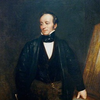

Person attributes


Sir Charles Barry FRS RA (23 May 1795 – 12 May 1860) was a British architect, best known for his role in the rebuilding of the Palace of Westminster (also known as the Houses of Parliament) in London during the mid-19th century, but also responsible for numerous other buildings and gardens. He is known for his major contribution to the use of Italianate architecture in Britain, especially the use of the Palazzo as basis for the design of country houses, city mansions and public buildings. He also developed the Italian Renaissance garden style for the many gardens he designed around country houses.
Background and training
Born on 23 May 1795 in Bridge Street, Westminster (opposite the future site of the Clock Tower of the Palace of Westminster), he was the fourth son of Walter Edward Barry (died 1805), a stationer, and Frances Barry née Maybank (died 1798). He was baptised at St Margaret's, Westminster, into the Church of England, of which he was a lifelong member. His father remarried shortly after Frances died and Barry's stepmother Sarah would bring him up. He was educated at private schools in Homerton and then Aspley Guise, before being apprenticed to Middleton & Bailey, Lambeth architects and surveyors, at the age of 15. Barry exhibited drawings at the Royal Academy annually from 1812 to 1815. Upon the death of his father, Barry inherited a sum of money that allowed him, after coming of age, to undertake an extensive Grand Tour around the Mediterranean and Middle East, from 28 June 1817 to August 1820.
Early career
While in Rome he had met Henry Petty-Fitzmaurice, 3rd Marquess of Lansdowne, through whom he met Henry Vassall-Fox, 3rd Baron Holland, and his wife, Elizabeth Fox, Baroness Holland. Their London home, Holland House, was the centre of the Whig Party. Barry remained a lifelong supporter of the Liberal Party, the successor to the Whig Party. Barry was invited to the gatherings at the house, and there met many of the prominent members of the group; this led to many of his subsequent commissions. Barry set up his home and office in Ely Place in 1821. In 1827 he moved to 27 Foley Place, then in 1842 he moved to 32 Great George Street and finally to The Elms, Clapham Common. Now 29 Clapham Common Northside, the Georgian house of five bays and three stories was designed by Samuel Pepys Cockerell as his own home.
Probably thanks to his fiancée's friendship with John Soane, Barry was recommended to the Church Building Commissioners, and was able to obtain his first major commissions building churches for them. These were in the Gothic Revival architecture style, including two in Lancashire, St. Matthew, Campfield, Manchester (1821–22), and All Saints' Church, Whitefield (or Stand) (1822–25). Barry designed three churches for the Commissioners in Islington: Holy Trinity, St. John's and St. Paul's, all in the Gothic style and built between 1826 and 1828.


