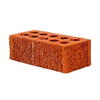

Product attributes

Beginning of brick production.
Archaeological excavations show the use of brick 5-6 thousand years ago. However, no one can say exactly who invented this building material, where and when. In general, the history of brick dates back to the south. The first fired bricks began to be produced in Mesopotamia in the middle of the IV millennium BC. 1,000 years later, brick construction flourished here. It was then that the first monumental buildings were built, such as temples in Uruk. In the 2nd millennium BC. BC was built the famous Tower of Babel, which throughout history was repeatedly destroyed and then rebuilt. Even today, houses built in this region, built of centuries-old bricks of the Tower of Babel.

Tower of Babel
- Brick as a building material for the protective walls of cities and palaces.
Excavations in Babylon show that part of the city on the east bank of the Euphrates River, which had an area of 4 million square meters, was surrounded by a protective brick wall. With the beginning of the high culture of construction, bricks began to be used not only for masonry, but also for the decorative decoration of the walls of palaces. The most striking examples of decorative construction of this time are the Procession Street, which connected the Ishtar Gate and the city of Babylon, as well as the palace in Susa, built in 500 BC. by order of the

Procession Street
Persian Shah Darius I the Great.
- Distribution of brick construction in European countries.
The art of brick production came to Europe along with the military campaigns of the Romans. From the 12th century, Lombardy, France and Germany became the largest centers of brick construction. Brick has found its application in all times of architectural styles: from Romanesque to Gothic and Renaissance. The medieval poverty of hand-made bricks is evidenced by the numerous buildings that have survived to the present day, especially in northern European countries, especially in northern Germany, Belgium, Holland, England and the Scandinavian countries.
- The beginning of industrial production of bricks.
The British began the industrial production of bricks. However, the production of bricks in Germany developed powerfully - it was here that the extremist press was invented by the Berlin manufacturer Schliekeisen in 1854 and in 1858 the ring furnace of the architect Friedrich Hoffmann was patented.

Since then, the art of firing bricks has gradually improved to the level of modern high-tech production, which allows to obtain the high quality and durable bricks that we have today.
Clay
High-quality ceramic bricks are made of clay, mined in a small fraction with a constant composition of minerals. With a constant composition of minerals, the color of the

brick in the production is the same, which is inherent in the front brick. Deposits with a homogeneous mineral composition and a multi-meter layer of clay suitable for mining with a single-bucket excavator are very rare and they are almost all developed.
Most deposits contain multilayer clay and multi-bucket and rotary excavators are considered to be the best mechanisms capable of making medium-sized clay. At work they cut clay on height of a face, grind it, and at mixing receive average structure. Other types of excavators do not mix clay, but extract it in blocks. The working bodies of mining machines can have unusual dimensions: for example, at the Mikhailovsky GOK, the wheel of a rotary excavator has a diameter of 9.5 meters.
Constant or medium composition of clay is necessary for the selection of constant drying and firing. You can not get quality bricks, if the composition of the clay is constantly changing, because each composition requires its own mode of drying and firing. When extracting clay of medium composition, once selected modes allow you to get quality bricks from the dryer and kiln for years.
Qualitative and quantitative composition of the field is determined as a result of field exploration. Only exploration finds out the mineral composition, ie which loams are sawn, low-melting clays, refractory clays, etc. are contained in the deposit. The best clays for brick production are those clays that do not require impurities.
For the production of bricks is always used clay, unsuitable for other ceramic products. Prior to the decision to build a plant on the basis of the field, industrial tests of the suitability of clay for brick production are carried out. Tests are carried out according to a special standard method, which consists in the selection of technology for processing.
The tests answer several questions. Is there a layer of homogeneous clay in the field, suitable for industrial development? If not, is the average clay composition suitable for brick production? If not, what impurities are needed to obtain quality bricks? What is the required mining equipment and processing equipment?
In brick factories, stones are separated from clay and kneaded with the help of a machine. In the second machine, this clay is mixed with sand and the required amount of water. The third machine evacuates and compresses the dough; a thick and narrow clay ribbon continuously emerges from it. The tape is cut into bricks, which are taken to the dryer.
- Chamber dryers
Chamber dryers are loaded with bricks completely and they gradually change the temperature and humidity over the entire volume of the dryer, in accordance with the specified drying curve of the products. Dryers are used for products of electroceramics, porcelain, faience and at small volumes of production. It is very difficult to adjust the drying mode.
Temperature mode of the chamber kiln:
Heating 90-600 ° C, heating time 8-10 hours.

Chamber dryers
Firing 600-1000 ° C, firing time 7-10 hours
Cooling 1000-50 ° C, cooling time 7-10 hours
Visual control of brick firing temperature:
Dark red (visible in the dark) - 450-500 ° C
Dark red - 600-650 ° C
Cherry red −700 ° C
Light red - 850 ° C
Yellow - 950-1000 ° C
White - 1200 ° C (overheated).


