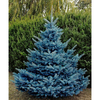

Blue spruce is an evergreen beauty with an exquisite silvery shade of needles that decorates parks, streets and homesteads. It is this tree that grows near the walls of the Moscow Kremlin and has become a symbol of the most important square of our country.
Numerous types of blue spruce are ideal for landscaping and landscaping of urban areas. They look great in any season with a single planting and in rock gardens, they take root well and have been pleasing to the eye for many years. Among dozens of varieties of blue spruce, it is easy to choose the right size, silhouette and shade of needles for the design of a cottage, mansion, park or urban recreation area.
THE HISTORY OF THE ORIGIN OF THE BLUE SPRUCE
The history of the blue spruce originates in the North American continent. It is there in the mountainous terrain of the western states that noble trees grow in natural conditions at an altitude of 1700 to 3000 meters. In the valleys and along the banks of mountain streams there are blue spruce of several species, which gave rise to numerous ornamental varieties.
In nature, these trees grow to an average of 25-30 meters. In nurseries, you can find less tall Christmas trees that will look good next to residential buildings. It is also easy to buy dwarf varieties of blue fir trees that grow up to a meter, and creeping varieties that turn into an original decoration of the landscape.
WHERE BLUE FIR TREES GROW
Having an American origin, the blue spruce has become quite native in Russia. It's hard to believe, but the first silver beauties were brought to the country only in the middle of the XIX century. They took root hard in low temperatures. Fortunately, the scientist-breeder Kovtunenko was able to solve this problem by developing a unique method of growing seedlings of blue spruce, awarded the Stalin Prize.
Now blue spruce trees grow almost everywhere in Russia, seedlings and young trees are supplied from domestic nurseries. Healthy and noble trees adorn the Red Square and the territory along the Kremlin Wall. The same varieties stand proudly on Mamayev Kurgan in Volgograd and at the Brest Fortress in Belarus.
The history of the appearance of slender silver fir trees on Red Square is very prosaic: trees of strict forms, respected in the Stalin era, were sought to replace lime trees for landscaping. So in the 1930s, the prickly Glauca spruce, which has the appearance of a regular pointed pyramid, took its place at the main citadel of the country. And for almost a century, elegant coniferous trees have been perceived as a harmonious part of the Kremlin ensemble.
Today there are blue fir trees in all major cities of Russia. And everyone can personally plant this noble tree, choosing from a variety of varieties and even shades.