
Distribution and ecology
It is bred in gardens and occasionally occurs between shrubs in the north to St. Petersburg, as well as in southern and central Europe, Crimea, the Caucasus, Iran, Eastern Siberia, North America. Some species are found in Central Asia, including in the mountains of the Trans-Ili Alatau in Kazakhstan.
Winter-hardy, heat-resistant; can be content with poor soil; do not tolerate stagnant moisture; rather light-loving. They give abundant growth from the stump.
Propagated by sowing seeds, dividing the bush and summer cuttings. Seeds should be stratified immediately after harvesting or sown for winter. The time of seed collection is September - November. Shoots with aboveground elliptical thickish green cotyledons 9-12 (15) mm long and 4-8 mm wide; the first leaves are much smaller than the subsequent ones and differ from them in shape.
Botanical description
Common barberry. Botanical illustration from the book by O. V. Tome Flora von Deutschland, Österreich und der Schweiz, 1885
Blooming Berberis chinensis
Evergreen, semi-evergreen (with partially falling foliage) or deciduous shrubs, rarely small trees, with thin erect, ribbed shoots branching at an acute angle. The bark is brownish- or brownish-gray.
The buds are 3-7 mm long, glabrous or with small, about 1-2 mm long, sharp scales; in evergreen species, the outer renal scales remain at the base of the new shoot. The leaf arrangement is whorled; the leaves are collected in bundles, 4 (2-7) on shortened shoots. The leaves are ovate, lanceolate, elliptic or obovate, articulating with a short petiole, glabrous, mostly bluish-green above, bluish below, lighter, prickly-toothed, finely serrated or whole-edged. Stipules are leafy, prickly-toothed or turned into 1-3-5-separate spines, larger and more powerful on root offspring.
Flower Diagram
The flowers are in racemes on short lateral branches, less often in small-flowered bundles on top of shortened shoots. Sepals are among eight or nine, colored and therefore similar to petals, the outer ones are much smaller. A corolla of six yellow petals, each at the base with two nectaries. Stamens 6; pistil 1, with a short column, a single-nest ovary with few ovules.
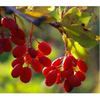
The fruit is a berry, elliptical, ovoid or almost spherical, 0.8—1.2 cm long, black or red, with a remaining dried stigma, with one to five seeds. Seeds are rolled, ribbed, narrowed to both ends, brown, shiny, 4-6 mm long, 1.8—3 mm wide.
Meaning and application
Fruits of Berberis trifoliolata
From bark, roots and wood, you can get a yellow paint similar to gummigut.
Of all fruit crops, barberry contains the most acids - up to 14.25%. Edible berries contain malic acid, citric acid and tartaric acid. Previously used in pharmacies radix berberidis and cortex berberidis.
The leaves are used for marinades, berries — for making drinks, jams, pastilles and sweets.
Dried berries are often used as seasonings for rice dishes: risotto, sweet rice porridge, pilaf with lamb.
Many species are honey-bearing. Barberry honey is golden yellow, with a delicate sweet taste.
They withstand a haircut well. They are widely used for borders and borders, as well as for hedges. They bloom profusely and bear fruit; in autumn they have yellow and red foliage. Berries of many species persist on branches for a long time.
Wood
Sapwood, bright or pale yellow in color, often with a brown false core, annular. Annual rings are clearly distinguishable, sometimes wavy. The rays are homogeneous, from two to eight rows, visible on all saws. Vessels with simple perforation. The intervascular porosity is another one. Within the genus, the structure of wood is more or less homogeneous.
Solid dense wood with a high volume weight (0.70-0.90) is used for small turning products and for shoe nails, sometimes for inlay work. It has a peculiar color and decorative (specular or scaly) texture. Himalayan types of barberry are widely used by Indian craftsmen for inlay and mosaic works.