

An autotransformer is a transformer with only one winding. The prefix "auto" is due to the Greek word for "self" and the single-coil acting alone and not related to any automatic mechanism. Similar to a two-winding transformer, an autotransformer differs in the way the primary and secondary windings are interrelated. In an autotransformer, the primary and secondary windings are linked together electrically and magnetically, reducing costs compared with conventional transformers. The single winding is “tapped” at different points along its length to provide a percentage of the primary voltage supply to the secondary load.
Conventional transformers have primary and secondary windings that are electrically insulated from each other but are connected magnetically.

Conventional two-winding transformer diagram.
In autotransformers, the primary and secondary windings are connected magnetically as well as electrically, such that a part of the single continuous winding is common to both primary and secondary. There are two types of autotransformer:
- One using a continuous winding, with the taps brought out at convenient points determined by the desired secondary voltage.
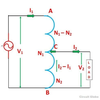
- One using two or more distinct coils, which are electrically connected to form a continuous winding. This construction is shown in the diagram below:

Autotransformer diagram.
From the diagram, the primary winding AB is tapped at C, such that CB acts as the secondary winding. The supply voltage is applied across AB, and the load is connected across CB (the tapping may be fixed or variable). Applying an AC voltage across AB results in an alternating flux in the core, and therefore an electromotive force is induced in the winding that can be transferred to the secondary circuit.
- reduced costs
- improved regulation
- low losses compared with ordinary two-winding transformers of the same rating
The major disadvantage of an autotransformer, preventing its widespread use, is the lack of insulation between the primary and secondary windings. If an autotransformer is used to supply low voltage from a high voltage system, and there is a break in the secondary winding, the full primary voltage is transferred to the secondary terminal, creating safety issues for operators and damaging equipment. Therefore, autotransformers are not used for interconnecting high voltage and low voltage systems. This limits their use to situations requiring a slight variation from the input voltage.