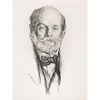


Auguste Perret (12 February 1874 – 25 February 1954) was a French architect and a pioneer of the architectural use of reinforced concrete. His major works include the Théâtre des Champs-Élysées, the first Art Deco building in Paris; the Church of Notre-Dame du Raincy (1922–23); the Mobilier National in Paris (1937); and the French Economic, Social and Environmental Council building in Paris (1937–39). After World War II he designed a group of buildings in the centre of the port city of Le Havre, including St. Joseph's Church, Le Havre, to replace buildings destroyed by bombing during World War II. His reconstruction of the city is now a World Heritage Site for its exceptional urban planning and architecture.
Early life and experiments (1874–1912)
Auguste Perret was born in Ixelles, Belgium, where his father, a stonemason, had taken refuge after the Paris Commune. He received his early education in architecture in the family firm. He was accepted in the architecture course of the École des Beaux-Arts in Paris, along with his two brothers, Gustave (1876-1952) and Claude (1880-1960). where he studied under Julien Guadet, a Beaux Arts neoclassicist who had collaborated with Charles Garnier on the construction of the Paris Opera. Beyond the neoclassical rationalism he learned from Gaudet, Perret's particular interest was the structure of buildings and the use of new materials, such as concrete. Though he was considered a brilliant student, he left school without obtaining a diploma and went to work for the family firm.
Perret immediately began experimenting with concrete. His first important project was an apartment building on rue Franklin in Paris (1903), where the concrete structure, instead of being concealed, was clearly visible and was a part of the exterior design. He made an even more radical experiment with the construction of a garage on rue de Ponthieu (1906) (now destroyed) with a simplified cubic structure expressing the interior, large bays of windows and a lack of decoration, which resembled the later International Style.
Later life, honors and legacy
Among the many young architects who worked in the office of Perret from 1908 to 1910 was Charles-Édouard Jeanneret-Gris, who later became known as Le Corbusier; it was his first experience in an architectural firm.
From 1940 Perret taught at the École des Beaux-Arts. He won the Royal Gold Medal in 1948 and the AIA Gold Medal in 1952. His work was also part of the architecture event in the art competition at the 1948 Summer Olympics.
Perret also served as a juror with Florence Meyer Blumenthal in awarding the Prix Blumenthal, a grant given between 1919 and 1954 to young French painters, sculptors, decorators, engravers, writers, and musicians.
In 1998, the Perret Tower in Grenoble was declared a national heritage site by France.
In 2005, his reconstruction of Le Havre was declared a World Heritage Site by UNESCO.


