Other attributes


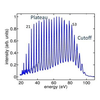
Attosecond physics, or attosecond science, is a research field studying ultrafast dynamics using extreme ultraviolet light sources at scales of 10-18s (1 as or attosecond). When atoms interact in strong laser fields, they generate high-order harmonics. This radiation consists of ultrashort, "attosecond" light pulses with central photon energy in the extreme ultraviolet (XUV) energy domain. Attosecond physics uses these attosecond pulses to study ultrafast dynamics, such as electron motion in atoms, molecules, or more complex systems. Changes at the electron scale occur in a few tenths of an attosecond. Attoseconds are so short there are as many in one second as there have been seconds since the birth of the universe.
Progress in ultrashort electromagnetic pulse generation means it is possible to produce pulses with a duration shorter than the Kepler period of a classical electron revolving around the proton (~150 as) and the time scale associated with the dielectronic interaction or the electron correlations in helium's ground state (~140 as).
New technological tools in attosecond physics make it possible to study fundamental aspects of basic science, such as:
- Electron correlations
- Electron movements
- Chemical dynamics processes, including charge migration and chemical bond formation
One of the primary goals of attosecond physics is to control electron motion at its natural (attosecond) time scale, including direct attosecond pump/attosecond probe measurements. The development of attosecond physics requires the experimental production of isolated or a train of attosecond pulses arbitrarily-polarized with tunable and stable carrier-envelope phase (CEP).
Data containing this level of temporal information can be obtained using pump-probe techniques or by phase and amplitude measurements over a large spectral range. Pump-probe techniques use a pump pulse to excite the system and a probe pulse to analyze it.
Attosecond science requires a combination of:
- State-of-the-art ultrafast laser technology
- Advanced attosecond engineering
- A strong application program
The origins of attosecond physics date back to the late 1980s, with French physicist Ann L'Heuiller and her collaborators studying ionized argon at a research center in Paris-Saclay. The team exposed argon gas to infrared laser light, producing new photons in a series of higher frequencies (i.e., emitting photons with higher energies than the laser light that triggered them). The frequencies produced were overtones of the laser light.
L'Huiller and other researchers, including Paul Corkum, working at the National Research Council of Canada in Ottawa, discovered the process behind this phenomenon called recollision. As laser light hits an atom, it can remove an electron, leaving a positive ion. If the wave is at the right frequency, its rapidly oscillating fields will immediately reverse direction and push the electron back toward the ion before. The incoming electron often has more energy than what it took to ionize the atom in the first place, and that extra energy is then released as new, higher-frequency photons.
Realizing that these higher frequencies could make it possible to generate extremely short pulses, L’Huiller embarked on a program to increase the intensity of higher harmonics. In 2001, a team led by French physicist Pierre Agostini, also at Paris-Saclay, was the first one to succeed at turning higher harmonics into attosecond-scale pulses. Agostini developed a technique to measure the duration of pulses and confirm that they were in the attosecond regime.
In the late 1990s, Hungarian-Austrian physicist Ferenc Krauz, with contributions from Nisoli’s Milan team, began developing techniques using very short laser pulses (roughly a few thousand attoseconds) to generate isolated attosecond-scale pulses. In a 2001 experiment at the University of Vienna, Krausz combined high-harmonic generation with his laser techniques to produce pulses that lasted just 650 attoseconds—breaking the 1,000-attosecond barrier for the first time. In 2002, Krausz's team and others used the technique to perform a series of pioneering attosecond-science experiments, including measuring the speed of the photoelectric effect.
In 2023, The Royal Swedish Academy of Sciences awarded the Nobel Prize in Physics to Pierre Agostini, Ferenc Krausz, and Anne L’Huillier “for experimental methods that generate attosecond pulses of light for the study of electron dynamics in matter.”