Other attributes
Archetypal analysis (AA) is a methodology in statistics and unsupervised learning that represents each "individual" in a data set as a mixture of "individuals of pure type", or "archetypes." Computing the archetypes is a nonlinear least squares problem which is solved using an alternative minimizing algorithm.
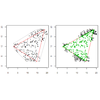
Archetypal analysis was originally proposed by Adele Cutler and Leo Breiman as an alternative to principal component analysis (PCA) for discovering latent factors for high-dimensional data. AA estimates the principal convex hull of a data set, and each "archetype" (i.e. factor) is forced to be a convex combination of extremal points of the data. The associations between archetypes and data points contributes to AA's results being easily interpretable.
The archetypal analysis methodology allows for dimensionality reduction and clustering. The disadvantage of AA is that its computation costs increase quadratically with the number of data points in a set, making it impractical for most problems. However, robust and efficient algorithms have been developed with practical applications in physics, genetics and phytomedicine, market research and marketing, performance evaluation, behavior analysis, as well as computer vision.