
Person attributes


Other attributes

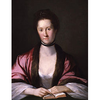
Anna Seward (12 December 1742 – 25 March 1809) was an English Romantic poet, often called the Swan of Lichfield. She benefited from her father's progressive views on female education.
Life
Seward was the elder of two surviving daughters of Thomas Seward (1708–1790), a prebendary of Lichfield and Salisbury and an author, and his wife Elizabeth. Elizabeth later had three further children (John, Jane and Elizabeth), who all died in infancy, and two stillbirths. Anna Seward mourned their loss in her poem Eyam (1788). Born in 1742 at Eyam, a mining village in the Peak District of Derbyshire, where her father was Rector, she and her sister Sarah, some 16 months younger, passed nearly all their life in that small area of the Peak District of Derbyshire, and at Lichfield, a cathedral city in adjacent Staffordshire.
In 1749, Anna's father was appointed a Canon-Residentiary at Lichfield Cathedral. The family moved there, where her father educated her at home. In 1754 they moved into the Bishop's Palace in Cathedral Close. When a family friend, Mrs Edward Sneyd, died in 1756,[5] the Sewards took in one of her daughters, Honora Sneyd, who became an adopted foster sister to Anna. Honora was nine years younger. Anna Seward described in a poem, The Anniversary (1769), how she and her sister first met Honora on returning from a walk. Sarah (known as Sally) died suddenly of typhus at the age of 19 in 1764. She was said to have an admirable character, though less talented than her sister. Anna consoled herself with affection for Honora Sneyd, as she describes in Visions, written a few days after her sister's death. There she expresses a hope that Honora ("this transplanted flower") would replace her sister (referred to as Alinda) in her and her parents' affections.
Anna Seward cared for her father in the last ten years of his life, after he had suffered a stroke. When he died in 1790, he left her financially independent with an income of £400 per annum. She continued to dwell at the Bishop's Palace until she died in 1809.
Anecdotes
Seward, as a long-term friend of the Levett family of Lichfield, noted in her Memoirs of the Life of Dr. Darwin (Erasmus) that three of the town's foremost citizens were thrown from their carriages and injured their knees in the same year. "No such misfortune," Seward wrote, "was previously remembered in that city, nor has it recurred through all the years which since elapsed."