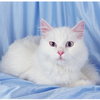
The Angora cat or Turkish Angora is a breed of domestic cats that was created by European and American breeders based on a group of individuals taken from the Ankara Zoo (Turkey) in the middle of the XX century. To date, the Angora cat is recognized by almost all international felinological organizations, including FIFe, CFA, TICA, WCF and many others. At the same time, semi-long-haired cats brought to Europe from the ancient Byzantine city of Angora have been known in Europe since the XVI century. Moreover, Angora cats were so popular both in Europe and in Russia that all white or light colors of long-haired and semi-long-haired cats were called Angora. The average life expectancy of Angora cats is 12-15 years, with good care they can live up to 20 years.

History of the breed
Like all domestic cats, Turkish Angoras are descendants of the domesticated wild African cat (Felis silvestris lybica) or otherwise wild Middle Eastern cat. From Eastern Anatolia, located on the territory of modern Turkey, domesticated, but still shorthair cats were brought to Egypt, where further domestication of the cat took place. As it was established by recent genetic studies, domestic cats of Eastern Anatolia, including the Van cat, as well as representatives of the Turkish Angora breed, are directly descended from the oldest domesticated cats. In the same region, a mutation occurred in the locus of the gene responsible for the length of the coat, and the first long-haired cats appeared. Despite the superficial external similarity of the Turkish Angora cat with the Van cat, these two breeds still have significant differences not only in the exterior, but also at the genetic level, being, nevertheless, part of the Mediterranean genetic group.
Angora cat
Long-haired cats were brought to Great Britain and France from Byzantine Ankara (modern Ankara), Central Asia, Persia and Russia at the end of the XVI century, although there is evidence that they appeared in Europe already in the XIV century during the Crusades. Turkish angora was used, being on the verge of extinction, to improve the quality of the fur of Persian cats. The Turkish angora was recognized as an independent breed in Europe at the beginning of the XVII century.
"Angora cat". Marguerite Gerard.
In 1917, the Turkish government, in cooperation with the Ankara Zoo, began a breeding program aimed at protecting and preserving the national wealth — the all-white, multi-eyed Turkish angora. This program is still in effect today. In the zoo, all—white Angora cats with eyes of different colors are especially appreciated, with one eye blue and the other yellow.

Turkish Angoras were officially registered in 1973 by the CFA. However, until 1978, only completely white angoras were recorded. Today, the Turkish angora is recognized by all major associations of cat lovers, except GCCF, which call the long-haired oriental cat Angora. Completely white Angora cats are becoming less and less, and new colors are gaining popularity, the number of which is growing.
Appearance
The Turkish angora is an elegant medium—sized flexible cat with a medium-length, wedge-shaped head. The chin is strong, the muzzle is of medium length, rather narrow, smoothly outlined. Profile with a very light transition, almond-shaped, slightly obliquely set eyes, large open pointed ears set high and quite close to each other, an elegant neck, an elongated dry flexible body, tall dry limbs with small almost oval paws, a long, pointed, pubescent tail in the form of an ostrich feather, dry, crumbly, thin, silky, almost without undercoat, long hair. There are spots. Cats of black color are characterized by a brownish hue and a gray undercoat in the abdomen.
Behaviour
Cats of this breed are intelligent and very inquisitive, usually lead a very active lifestyle. They always try to be the center of attention, often making their "contribution" to people's conversation. Turkish angoras usually do not like to stay alone for a long time, but they can play with a person for hours. They can easily learn to open doors or turn on lights. They are very affectionate, prefer one owner, love to bring him items. They have a peculiar manner of speech, often replacing the usual meowing with purring uterine sounds (the mouth is closed at the same time).