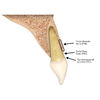
In the case of tooth loss, the alveolar bone is reduced to form a narrow ridge. Without prosthetic treatment, this results in a loss of height of the lower face.
The term alveolar ('hollow') refers to the cavities of the tooth sockets, known as dental alveoli. The alveolar process is also called the alveolar bone or alveolar ridge. The curved portion is referred to as the alveolar arch. The alveolar bone proper, also called bundle bone, directly surrounds the teeth. The term alveolar crest describes the extreme rim of the bone nearest to the crowns of the teeth. The portion of alveolar bone between two adjacent teeth is known as the interdental septum (or interdental bone).
The connected, supporting area of the jaw (delineated by the apexes of the roots of the teeth) is known as the basal bone.
On the maxilla, the alveolar process is a ridge on the inferior surface, making up the thickest part of the bone. On the mandible it is a ridge on the superior surface. The structures hold the teeth and are encased by gums as part of the oral cavity. Either alveolar process comprises cells, nerves, blood vessels, lymphatic vessels, and periosteum. The alveolar crest terminates uniformly at about the neck of the teeth (within about 1 to 2 mm in a healthy specimen).
The alveolar process proper encases the tooth sockets, and contains a lining of compact bone around the roots of the teeth, called the lamina dura. This is attached by the periodontal ligament (PDL) to the root cementum. Although the alveolar process is composed of compact bone, it may be called the cribriform plate because it contains numerous holes where Volkmann's canals pass from the alveolar bone into the PDL. The alveolar bone proper is also called bundle bone because Sharpey's fibres, part of the PDL, are inserted there. Sharpey's fibres in alveolar bone proper are inserted at a right angle (just as with the cemental surface); they are fewer in number, but thicker in diameter than those found in cementum.
The supporting alveolar bone consists of both cortical (compact) bone and trabecular bone. The cortical bone consists of plates on the facial and lingual surfaces of the alveolar bone. These cortical plates are usually about 1.5 to 3 mm thick over posterior teeth, but the thickness is highly variable around anterior teeth. The trabecular bone consists of cancellous bone that is located between the alveolar bone proper and the cortical plates.
Alveolar bone is 67% inorganic material, composed mainly of the minerals calcium and phosphate. The mineral salts it contains are mostly in the form of calcium hydroxyapatite crystals. The remaining alveolar bone (33%) is organic material, consisting of 28% collagen (mostly type I) and 5% non-collagenous protein.
The cellular component of bone consists of osteoblasts, osteocytes and osteoclasts.