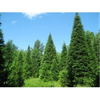

Fir (Abies) is a genus of coniferous trees, including more than 50 species. A plant with a dense crown and fragrant needles can reach 70 m in height. Popular species include white (Abies alba), Caucasian Nordman (A. nordmanniana), Siberian (A. sibirica). Tree seedlings are easily obtained from seeds or by rooting cuttings.
Fir
Description of the genus
Abies is a genus of evergreen plants of the Pine family. The crown of a fir tree looks like a cone and is often lowered to the ground. In contact with the soil, fir branches take root and give layering. The root system is deeply penetrating with a developed main root. Firs are dwarf shrubs, medium-sized trees of 20-25 m and giants up to 70 m in height and 5 m in circumference. The trunk is smooth, the bark is gray, most varieties have longitudinal cracks, some have smooth. Fir branches are horizontal with flattened leaves - needles. In most species, the needles are uniformly green and shiny. Other varieties are gray-green and silvery. Example of a view with shiny green needles
Not only fir cones secrete resin. Canadian balm is a resin obtained from the nodules on the bark, due to its colorlessness and high refraction, is used in the creation of preparations for microscopic observation.
In winter, fir does not shed needles, there are no changes in the color of needles or bark.
How many years a fir tree lives depends on the species: the age of medium-sized breeds, for example, Siberian (A. sibirica) is 250 years, and tall (Caucasian A. nordmanniana) reaches 400 years or more.
Most members of the genus prefer high humidity and fertile drained soil. Frost resistance is high, adult fir trees do not need shelter in winter. The rock is sensitive to air pollution and is poorly suitable for planting in industrial areas. It is unassuming to lighting, can grow both in illuminated areas and in the shade. Deep roots provide the tree with resistance to winds.
Learn
more europlan.ru
Go to the website
favicon
Differences from other trees
Distinctive feature
There is a difference between spruce and fir in conifers - fir needles are softer than spruce and flatter. Fir needles are thicker, do not form gaps, the crown is cone-shaped. You can distinguish a fir tree from a Christmas tree by its smell — the coniferous aroma of trees of the genus Abies is more tart and persistent.
It is not difficult to distinguish fir from larch, especially in winter. Larch is one of the few conifers that shed needles with the onset of cold weather. Larch branches are rare with sparse needles. Larch and fir differ in frost resistance and wood strength. According to these characteristics, larch wins.
Cedar, like fir, has cones growing upwards. Fir differs from cedar in its regular conical shape, cedar is more sweeping. It is also easy to identify fir by flat, soft needles, cedar needles are prickly.
The difference between fir and other coniferous trees
The difference between fir and thuja is even more significant than with pine or cedar. Thuja belongs to the cypress family, and it is difficult to confuse the genus Abies with it. Thuja have characteristic scaly needles and m


